
Porsche Cayenne Common Problems
Common Reliability or Mechanical Issues Diagnosed on the Porsche Cayenne
 Porsche Cayenne Common Problems, Symptoms, Reliability and Known Repair Solutions
The Porsche Cayenne is one of the most capable and dependable performance SUVs, but every generation has its own mechanical weaknesses, reliability concerns and potential repair costs. Here we explain the most common Porsche Cayenne problems affecting the 955, 957, 958 and 9Y0 generations. Organized by system category and symptom, our guidance covers engine faults, oil leaks, cooling systems, transfer case and transmission problems, air suspension, electrical faults, dashboard warnings and other known mechanical issues.
We also highlight relevant Porsche technical bulletins, software updates, recalls and extended warranty information to help owners understand their options before committing to expensive repairs.
An accurate diagnosis by an experienced Porsche specialist can save considerable time and money. PcarWise connects owners with independently vetted Porsche repair specialists who understand these vehicles. If you’re researching and considering buying a used Cayenne, our Cayenne buying guides highlight the mechanical issues and potential ownership costs to consider before making a purchase.
 Here’s What to Do if You See Warning Lights, Messages, or Symbols on Your Porsche Cayenne Dashboard
Many Porsche Cayenne mechanical problems are accompanied by dashboard warning lights, messages or symbols. Unfortunately, there are considerably more potential problems than warning lights, and the messages don’t always make the cause particularly clear. Our Porsche Dashboard Warning Lights, Messages, and Symbols guide explains what the warnings mean and what action to take next.
Could Maintenance Solve a Porsche Cayenne Problem?
Maintenance rarely solves an existing mechanical problem. However, neglected maintenance can cause expensive failures. Check your service history against our recommended Cayenne maintenance schedules.

Scanned Your Cayenne and Read Diagnostic Codes?
Check engine light? Have you scanned your Cayenne and are now not sure what those OBD codes actually mean? Our article on how to interpret and make sense of fault codes may help. The following sections identify common problems through their symptoms. If you’ve already scanned your Porsche OBD2 system and identified fault codes, go to our Porsche powertrain fault code page to get additional fault code descriptions.
Can’t Find An Answer Below? – Contact Us For Help
If your Cayenne has mechanical issues that don’t appear here, simply drop us an email via the forms or pop-up chat box and we’ll do our best to help identify a solution.
Porsche Cayenne Reliability
The Porsche Cayenne has an excellent reputation for performance, practicality and long-term dependability. Later generations are generally reliable, while older models can experience age-related mechanical problems and some well-documented weaknesses, particularly in the cooling system, drivetrain and air suspension.
Reliability varies by generation, engine, maintenance history and how the vehicle has been driven. Some problems are relatively straightforward to resolve, while others, including engine damage, transfer case failures and complex suspension or hybrid system faults, can involve substantial repair costs. Accurate diagnosis is particularly important, as replacing expensive components unnecessarily can quickly turn a manageable problem into a costly repair.
Of course, you’re driving a Porsche, so comparing repair costs with an ordinary SUV rather misses the point in our opinion! Regular maintenance, early diagnosis and the expertise of experienced Porsche specialists are the best ways to avoid unnecessary repairs. In general, there’s no reason a properly maintained Cayenne shouldn’t provide years of enjoyable ownership.
Porsche Cayenne Common Problems by Symptom – 955 | 957 | 958 | 9Y0
Porsche Cayenne – Technical Updates and Warranty Extensions
Owners of newer Porsche Cayenne models should be aware that certain mechanical and electronic problems may have specific Porsche repair procedures, software solutions, recalls or extended warranty coverage. PcarWise highlights relevant technical information throughout the sections below, including transfer case faults, engine management, cooling systems, suspension, electrical issues and other generation-specific concerns. Always confirm the applicable model year, fault codes and VIN before authorizing repairs or assuming warranty coverage.
Clicking on a heading below gives you more detail.
Engine
Check Engine Light - Power Loss - Incorrect Valve Lift - 957 - 958
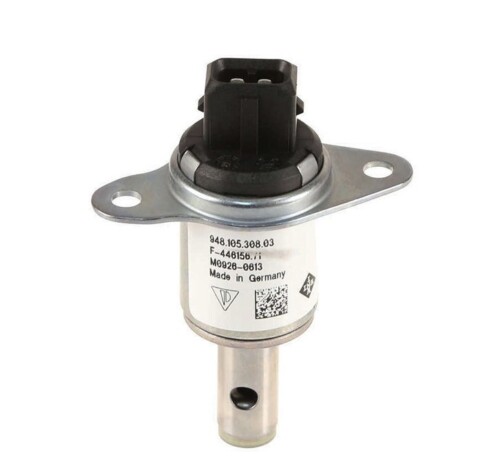 Symptoms: Loss of Power, Check Engine Light, Incorrect Valve Lift Fault
At times the V8 engine in the Porsche Cayenne will report a CEL for codes associated with incorrect valve lift on one of the two cylinder banks. There are several possible causes — one obvious and a few less so. The exact fault code matters, because Porsche uses different methods to monitor valve lift.
Valve Lift Solenoid Failure
First, an electromechanical solenoid controls the oil flow used to switch the valve lift. If it fails, the engine management system may report that the valve lift has not changed correctly. Replacing the solenoid can solve the problem. However, if the fault returns, check the electrical connections, oil supply and the specific fault-code test plan before replacing more parts.
O2 Sensor Problem
The answer can lie in a not-so-obvious location. For certain bank-wide valve-lift faults, Porsche uses the upstream oxygen-sensor signals and lambda control response to check whether the requested valve-lift change actually happened. A slow or ageing front O2 sensor can therefore produce a valve-lift fault even though the solenoid and mechanical lift system are working correctly. However, not all valve-lift codes are diagnosed this way, so the specific code and test plan are important.
If testing shows that the upstream O2 sensor is responding too slowly, replacing it may solve the problem. Don’t replace it simply because a valve-lift code is present.
Check Engine Light - Misfire - Dead Cylinder - Coils, Plugs, Lifters
Symptoms: CEL, Loss of Power, Misfire Under Load
There are multiple reasons why a check engine light can be set for misfires. A code scan can reveal which cylinder is misfiring but not usually exactly the reason why a misfire is happening.
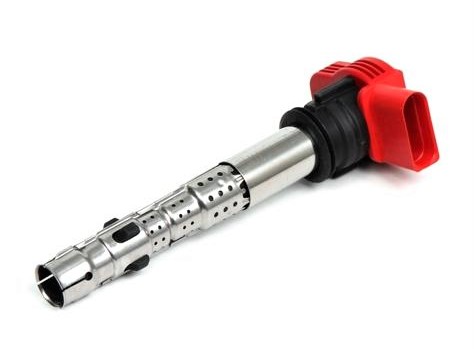 CEL – Misfire – Faulty Ignition Coil
The ignition coils on the Porsche Cayenne V8 have been updated a number of times. A single coil failure is typically a sign of more trouble to come from other coils. It’s usually best practice to update all the ignition coils if the problem is caused by age or mileage.
A failing coil typically stops any spark and sets a misfire code with a completely dead cylinder. This will cause rough running, especially at idle.
However, coils can also partially fail, where a weak spark causes misfires when the cylinder is loaded under acceleration. Clearing the fault may allow the engine to run well at idle, only for the misfire and CEL to return when the car is driven more aggressively.
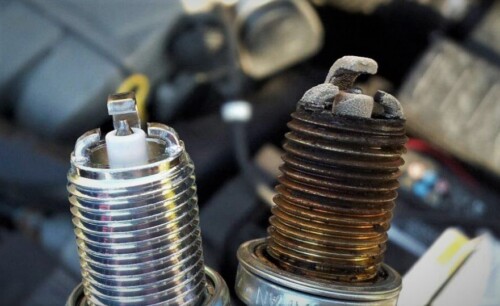 CEL – Misfire – Worn Spark Plugs
Service intervals between spark plug changes can seem rather long, considering the duty cycle required from a plug over a 30K mile period. Worn spark plugs typically initially produce a loss of power, a change in fuel consumption, and then set faults for misfires. With worn spark plugs, you may see misfires on one cylinder or random multiple misfires across the engine.
A shortcut to finding out if you have a plug or coil problem is to identify the cylinder that is misfiring and swap the coil from the misfiring cylinder with a coil from a known good cylinder. If the misfire moves with the coil, you have a coil problem. If the misfire stays on the original cylinder, the plug is a possibility, but don’t overlook the injector, compression, a vacuum leak or another mechanical problem.
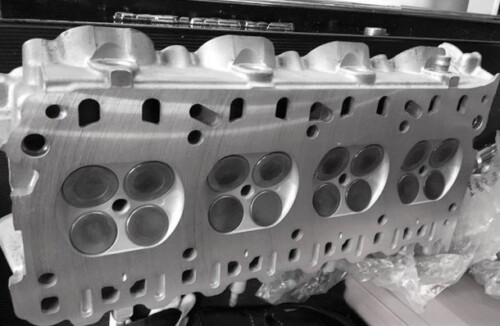 CEL – Misfire – Dead Cylinder
Typically associated with a CEL and rough running, the earlier V8 engine can experience a completely dead cylinder. Of course, checking the plug and coil is the first step but, if the problem persists, we’d recommend a compression test followed by a leak-down test to find out where the pressure is escaping.
One possible cause is an intake valve lifter that has stuck or failed, preventing a valve from operating or seating properly. If you’re lucky, the damage may be limited to the lifter or another valvetrain component.
In a more serious failure, a damaged valve spring, retainer or keeper can allow a valve to contact the piston. That requires considerably more extensive work, potentially including cylinder-head removal. Confirm the mechanical failure before assuming a lifter is the culprit.
Misfire – Broken Valve Springs – 2021–2022 Cayenne
Symptoms: Check Engine Light, Rough Running, Misfire, Engine Power Reduced, Limp Mode
A misfire does not always mean a bad plug, coil or injector. Porsche has documented cases of broken valve springs on certain 2021–2022 Cayenne 9YA V6 and V8 engines. The symptoms can look exactly like an ordinary ignition problem: rough running, a check engine light, a cylinder-specific misfire and sometimes a reduced-engine-power message.
The awkward part is that the fault codes alone do not identify a broken spring. Porsche’s technical information describes a manufacturing batch of valve springs that could fracture, often very early in the engine’s life. If a misfire will not respond to normal ignition and fuel checks, the next step is to establish whether the cylinder can actually seal and make compression. On an affected low-mileage engine, an experienced technician may be able to identify a valve that is not seating properly with a borescope before committing to more invasive work. A leak-down result on its own can be misleading in this situation.
This is not a reason to assume every misfiring Cayenne has a damaged valvetrain. However, it is an important possibility to eliminate when the symptoms and model year fit. Where a broken valve spring is confirmed, Porsche’s procedure calls for replacement of all the intake and exhaust valve springs, not just the one that failed. The extent of any additional damage determines how substantial the repair becomes.
Knocking or Shuddering Under Acceleration – Fuel Injector Misfire – 9Y0
Symptoms: Jerking, Shuddering or Knocking Under Acceleration – Sometimes No Check Engine Light
One of the more expensive mistakes you can make with a later Cayenne is to decide that a vibration or shudder under acceleration must be the transfer case. Sometimes it is. However, Porsche has documented another fault that can feel remarkably similar — an engine misfire caused by a fuel injector, without a check engine light or even a stored DME fault code.
On the 9Y0 Cayenne, the complaint can appear at part throttle or under hard acceleration. From the driver’s seat, the car jerks or vibrates and the sensation can easily be mistaken for a drivetrain problem. Porsche’s SY 41/21 procedure specifically tells technicians to check the injectors before replacing the transfer box. The workshop records the misfire counters for each cylinder with PIWIS while driving the car in the exact conditions that cause the problem.
If one cylinder begins registering misfires under load, the next step is to separate a plug or ignition coil fault from an injector problem with the correct swap-and-retest procedure. Only after those checks does injector replacement become a sensible decision. We would not condemn a transfer case, or start throwing expensive fuel-system parts at the car, simply because it judders. Reproduce the symptom, capture the misfire data and diagnose what is actually causing it.
E-Hybrid Engine Misfire – Crankshaft Sensor Wheel Adaptation
Symptoms: Check Engine Light, Engine Running Faults, Misfire Codes – 2019–2020 Cayenne E-Hybrid
A check engine light with a string of misfire faults usually sends the technician in search of a cylinder problem. Plugs, coils, injectors, fuel pressure and compression all deserve consideration. However, Porsche has identified a much more straightforward explanation for a particular fault combination on some 2019–2020 Cayenne E-Hybrid models — the crankshaft sensor wheel adaptation has not been completed correctly.
Porsche SY 25/20 concerns the 9YA Cayenne E-Hybrid in the US and Canada with the specified emissions equipment. Multiple misfire faults, including P030000 and cylinder-specific P030100–P030600 codes, may be stored together with P036300. Porsche directs the workshop to check the adaptation status in the DME and, where required, carry out the prescribed PIWIS adaptation drive.
This isn’t a magic fix for every E-Hybrid misfire. The exact model, equipment, fault combination and adaptation status have to match. But it does mean that before a workshop starts changing every ignition component on the engine, it should establish whether the engine management system has completed the adaptation Porsche requires. Sometimes the problem is the calibration, not the hardware.
Engine Power Reduced – Camshaft Sensor Fault Codes – 9Y0
Symptoms: Check Engine Light, Engine Power Reduced Warning, Camshaft Sensor Fault Codes – 2024–2026 Cayenne S and Cayenne Turbo E-Hybrid
A message telling you the engine power has been reduced tends to get your attention, especially when the diagnostic scan then points to a camshaft position sensor. The natural assumption is that a sensor has failed, or perhaps there is a more expensive camshaft timing problem. However, on certain later Cayenne models, Porsche has identified another possibility — the engine management software itself.
Porsche technical information TI 30/26 applies to 2024–2026 Cayenne S and Cayenne Turbo E-Hybrid models, including the relevant 9YA and 9YB versions. The particular fault pattern is important: P034100, P034600, P036600 or P039100 stored in the engine control unit together with the active check engine light and “Engine power reduced” warning. For this combination, Porsche directs the workshop to update the DME software using the appropriate PIWIS procedure. The guided programming also updates and recodes the Tiptronic transmission control unit.
That is a rather different repair from fitting a set of camshaft sensors and hoping for the best! It does not mean that every reduced-power warning is caused by software. A good Porsche specialist will read the exact codes, check the software level and apply the Porsche test plan before deciding whether the sensors, wiring, timing system or anything else requires attention.
Timing Chain Wear VR6 Engines - rattle sound
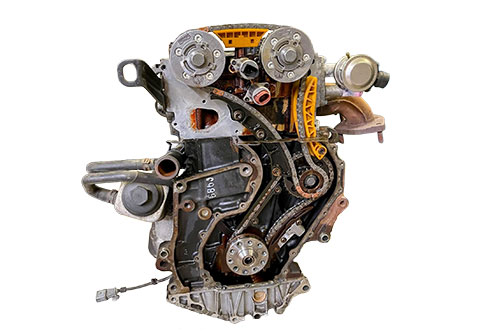 The timing chain in the VR6 engine connects the crankshaft with the camshafts and correctly times the movement of the valves and pistons. The chain runs over a number of plastic guides and is held tight by a chain tensioner.
Over time, wear in the chain, guides or tensioner can allow excessive slack. The result may be a chain rattle at start-up, camshaft timing correlation faults, rough running or, in the worst cases, a loss of engine timing.
This leads to misfires and potentially significant damage because the valves can make contact with the pistons – this is known as interference and is expensive to fix.
V8 Cold-Start Rattle – Camshaft Actuators – Later 9Y0
Symptoms: Brief Clacking or Rattling for One or Two Seconds After a Cold Start
A short metallic rattle when a cold V8 starts is not the most reassuring sound in the world, especially when you know what a timing-chain repair can cost. But before you authorize work on the camshafts, chain or tensioners, it is worth understanding what Porsche says about a very specific cold-start noise on some later engines.
For the 4.0L V8 bi-turbo engine covered by Porsche SY 49/26, a brief clacking or rattling sound lasting approximately one to two seconds after a cold start can come from the camshaft actuators while the oil is still cold and viscous. Porsche considers the noise described in its reference example normal and safe, and specifically says that replacing components will not resolve it.
The important words here are brief and cold start. A rattle that lasts considerably longer, appears when the engine is hot, becomes progressively louder or is accompanied by oil-pressure, camshaft-timing or misfire faults is a different situation and deserves proper diagnosis. A good Porsche shop can compare the actual noise with Porsche’s reference and decide which category yours belongs in. Don’t pay for a major engine repair just to cure a sound Porsche identifies as normal — but don’t dismiss a genuinely abnormal rattle either.
Fault Oil Pressure Monitoring Warning Message
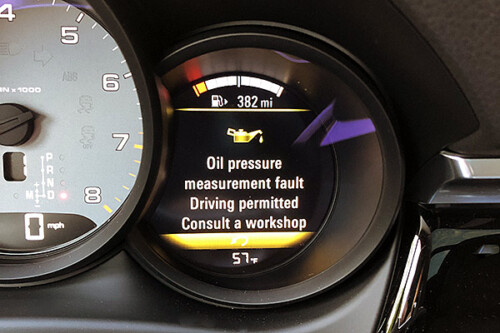 Symptoms: Warning Message – Oil Pressure Monitoring Drive on Permitted. Visit Workshop.
Cayenne owners can experience this message when driving. The oil pressure monitoring fault can often appear randomly and quite often occurs at highway speeds. Around town, the message is less likely to appear.
Oil pressure warnings can be scary. Genuine low oil pressure can cause catastrophic engine damage very quickly, so this is not something to ignore. If you get a red oil-pressure warning or a message telling you to stop the engine, switch it off safely and do not continue driving. An “oil pressure monitoring fault — drive on permitted” message is a different warning, but still needs prompt diagnosis to establish whether it is an electrical fault or a genuine pressure problem.
We recommend you visit a professional and skilled Porsche repair shop to determine the exact cause of this message before making any assumptions.
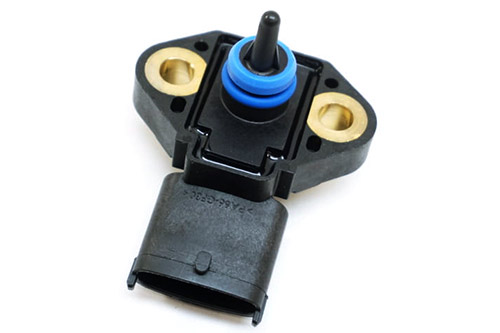 We are aware of owners who have had oil pumps and oil-pressure control components replaced, when the problem was actually a failed pressure sensor, wiring or an intermittent monitoring fault. However, genuine oil-pressure problems do occur. Before replacing parts, a specialist should check the fault memory and live data and, where necessary, confirm the mechanical pressure with a gauge.
The sensor or its wiring can fail an electrical test, giving an intermittent or implausible signal. Heat and vibration can make the problem more difficult to reproduce. Depending on the model and fault, a monitoring event may be stored without an obvious persistent CEL. That’s why the exact fault and the circumstances in which it occurred are important.
So, when you get to the shop without the message the problem is not there! Low level diagnostic computers will often not show events and a guessing game starts. Don’t let this happen. Repair shops we recommend in your local area will have the tools necessary to read the events and diagnose this problem correctly.
A leaking oil-pressure sender, an electrical oil-pressure monitoring fault and genuinely low oil pressure are three different problems. The warning message, engine condition, actual oil pressure and any VIN-specific campaigns determine which one you are dealing with.
Oil-Pressure Sender Leak – Porsche Campaign WTJ7
Symptoms: Fresh Oil Seepage or Oil Droplets Around the Oil-Pressure Sender – Selected 2026–2027 Cayennes
Most oil-pressure warnings lead owners to worry about the oil pump, while an external oil leak usually raises questions about gaskets or seals. On certain newer Cayenne V6 engines, however, Porsche has identified a very specific oil leak at the oil-pressure sender itself.
Under workshop campaign WTJ7, Porsche says the revised aluminum-housing sender was installed using insufficient tightening torque during production. That can allow oil droplets to form around the sender. The factory repair on an assigned vehicle is replacement of the sender, not simply wiping away the oil or tightening the original part by guesswork.
The campaign covers only selected 2026–2027 vehicles with the relevant 2.9L or 3.0L V6 engine and VIN assignment. This is a separate issue from an intermittent “Oil pressure monitoring — drive on permitted” message, and it should not be used as an explanation for a genuine low-pressure warning. If a relatively new Cayenne shows fresh oil around the sender, have the shop check campaign WTJ7 before authorizing a generic oil-leak repair.
Carbon Build-up - DFI Engines
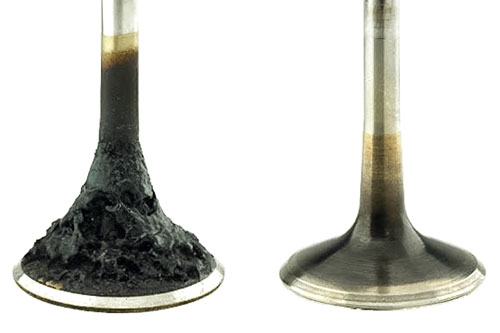 The direct-injection engines in the Cayenne can develop carbon buildup around the intake valves and ports. Unlike port injection, fuel is not continually washing over the back of the valves. Heavy deposits can restrict airflow and cause rough idle, misfires, hesitation or a loss of power under load. This can appear at higher mileages, but there is no fixed 60K–80K-mile point at which it should be expected.
The good news is that carbon buildup can normally be removed without replacing engine components. First, confirm that deposits are actually causing the symptoms. Porsche’s current cleaning procedure for affected engines uses a walnut-granule blasting system with the relevant intake valves closed. When the deposits are removed correctly, engine running and throttle response can improve considerably.
Common Oil Leaks
The Porsche Cayenne engines are generally reliable, although the likely oil-leak locations vary considerably between the V6, VR6 and V8 engines and across the different generations. The most commonly reported areas include:
- Valve Cover – Hardened gaskets or ageing sealant can leak oil onto hot exhaust components, producing a burning-oil smell.
- Camshaft Adjuster Solenoid Seals – Small O-rings leak oil down the front of the heads.
- Oil Separator / PCV System – A failed diaphragm or separator can cause abnormal crankcase pressure, oil consumption and, on some engines, external leaks.
- Timing Chain Covers, Camshaft Housings and Front Crankshaft Seal – Leaks can start as light seepage and become more significant with age. Access and repair costs vary by engine.
- Oil Filter Housing and Oil Cooler Seals – Common on both V6 and V8; seals flatten with heat and time.
- Rear Main Seal (RMS) – Seen on higher-mileage or neglected engines; oil drips between engine and transmission.
- Oil Pan Gasket – Usually only minor seepage.
- Turbo Oil Feed & Return Lines (V8 Turbo) – Heat causes O-ring hardening and leaks onto turbos.
V6 Cayenne - Check Engine Light - Vacuum Leak - PCV Failure
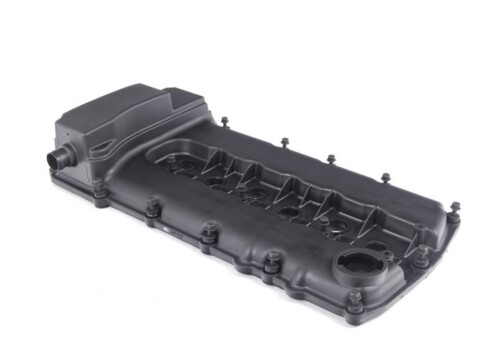 Symptoms: CEL – Power Loss – Lean Condition Fault Codes – Increased Fuel Consumption
An integral part of the emissions system on the 3.6L VR6 Cayenne is the PCV system. It separates oil mist from crankcase gases, returns the oil to the engine and routes the remaining vapors into the intake to be burned during combustion.
When the PCV system fails on the V6 Cayenne engine, it will develop a vacuum leak and set a CEL for lean running conditions – un-metered air enters the intake path through the PCV system and the engine has a loss of power.
PCV System Failure – V6 Cayenne
A failed PCV diaphragm can create excessive crankcase vacuum or incorrect crankcase pressure, depending on how it fails. This can cause rough running, lean-condition faults, oil consumption and sometimes oil leaks. A rear main seal leak may be related, but it should not automatically be blamed on the PCV system without checking crankcase pressure and the seal itself.
On many 3.6L VR6 versions, the PCV diaphragm or oil separator is integrated into the valve cover. Porsche’s conventional repair is replacement of the valve-cover assembly, although aftermarket diaphragm repair options exist. Confirm the engine version and failed component before ordering parts.
Check Engine Light - V8 Engine Failure - Cam Adjuster Bolts Break
Symptoms: CEL – Rough Running – Timing Faults
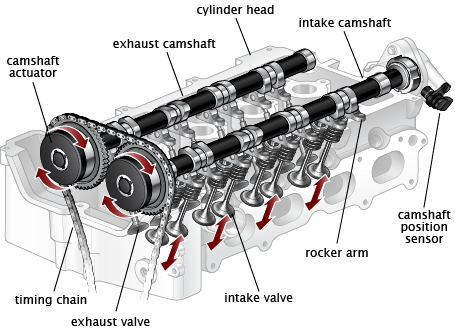 The much talked about camshaft-adjuster bolt problem affects certain V8 vehicles. For the US Cayenne, Porsche safety recall AH08 (NHTSA 17V368) identifies certain 2011 Cayenne S and Cayenne Turbo vehicles. The broader 2010–2012 date range includes Panamera models, so do not apply it to every Cayenne in those years.
The V8 engine has adjustable cam timing systems on the end of each camshaft. The timing chain drives the adjuster, which varies the position and rotation of the cam based on engine performance demands. The adjuster is bolted to the end of the camshaft.
Timing Chain Adjuster Bolts Fail
Unfortunately, the bolts holding the adjuster to the camshaft break and allow significant free play. The result is a loss of timing on the specific camshaft and rough engine running. This sets a check engine light and fault codes for multiple items including camshaft position sensor, misfires, and cam to crank timing faults.
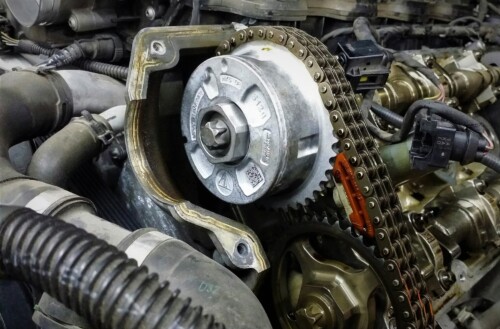 The bolts typically break or loosen at different times and set the faults first. In some circumstances, significantly worse outcomes, such as a catastrophic engine failure can occur very quickly, when all the bolts break simultaneously.
We experienced a V8 running very badly and setting faults for camshaft position sensor, misfires etc. Further investigation revealed that the intake camshaft was not rotating at all and all the bolts on the adjuster had broken.
Porsche V8 Engine Recall
Porsche recalled certain 2011 Cayenne S and Cayenne Turbo models under campaign AH08 to replace the fastening screws for the camshaft controllers and, where necessary, the controllers themselves. If you’re looking at one of these cars, check the VIN and confirm the recall work has been completed. Porsche’s official VIN recall checker or a local dealer can verify the record.
No Start - Fuel Pump Failure - CEL - Random Multiple Misfire
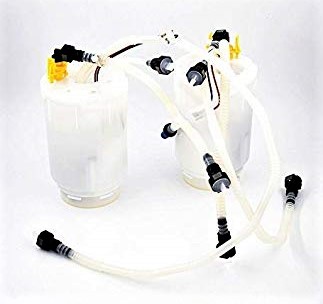 Symptoms: Engine No Start, Start and Die, CEL Random Multiple Misfires, Loss of Power
Fuel pump failures can occur on the Cayenne, particularly as the earlier cars age. Early models use low-pressure fuel delivery from the tank, with two in-tank pump units on certain versions. Later direct-injection (DFI) engines also have an engine-driven high-pressure fuel pump. The exact arrangement varies with engine and model year.
Low Pressure Fuel Pump Failure
Failure of the in-tank pumps is very common. Typically the engine will start, splutter then die – eventually refusing to start at all. This is caused by the pump overheating very quickly and shutting off. Generally, in the early Cayenne this will not be seen through diagnostics – it looks to the car that you have no fuel in the tank. However, checking the low-pressure fuel supply with the correct test procedure will reveal whether enough fuel is reaching the engine. On DFI engines, don’t confuse low-pressure supply testing with the very high pressure at the injector rail.
Porsche updated the in-tank pump assemblies on the earlier cars. Where both pumps are the same age, replacing both during one job may make sense, particularly if access is already required. However, confirm which unit has failed and inspect the filter, supply and associated wiring before authorizing parts. Fuel-pump replacement is not a job we’d recommend tackling without the right skills – use a professional Porsche repair shop.
High Pressure Fuel Pump Failure
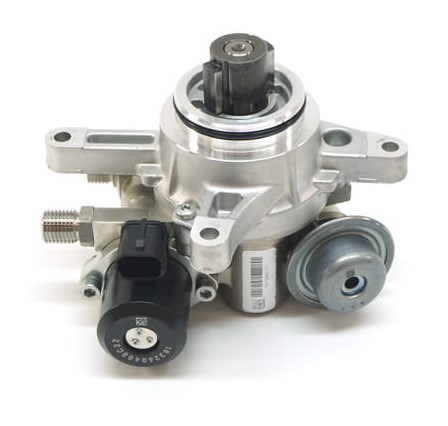 On the later engines with direct injection (DFI), the high pressure required to deliver fuel comes from a pump driven by the engine camshaft. A failure in the high pressure fuel pump has very similar symptoms to the failure of the in-tank pumps. However, there are sensors on the engine that report low fuel pressure conditions as fault codes to the diagnostic system and set a check engine light. Low pressure in the fuel system will usually begin as random multiple misfires and a loss of power under acceleration.
The key to solving this problem is diagnosing it correctly – the mechanical pump does fail quite commonly, however, if no fuel is being delivered from the tank because of a low pressure fuel pump failure, the high pressure pump will be unable to build fuel pressure for delivery to the injectors. This might look like a high pressure fuel pump problem when it isn’t! A good repair shop can accurately diagnose this for you.
Fuel Smell from Engine Compartment – Fuel and EVAP Line Connections
Symptoms: Fuel Odor, Visible Fuel Leak – Selected 2024 Cayenne 9YA/9YB
A fuel smell from the engine compartment should never be dismissed as a normal characteristic of a performance SUV. There are several potential causes, but Porsche also identified a production-related issue on a small group of 2024 Cayenne models where the fuel supply line, EVAP purge line or the spring-band clamps securing them may not have been installed in the correct position.
Porsche workshop campaign WPQ8 instructs technicians to check the connections and secure the hoses and clamps correctly where necessary. Although the EVAP system itself is part of the emissions arrangement, an incorrectly secured fuel supply connection can produce an actual fuel leak. That’s a rather different issue from a routine evaporative-emissions fault code or a failing fuel pump.
If the vehicle smells of fuel, arrange a proper inspection rather than continuing to drive. The campaign only applies to VINs assigned by Porsche, so checking the vehicle record is the first step. It’s another good reason to look for evidence of completed factory campaigns when buying a used Cayenne.
High-Pressure Fuel Pump Fasteners – Fuel Leak Recall ASA9
Symptoms – Fuel Smell, Check Engine Light or Fuel Leak – Selected 2024–2026 Cayenne Models
The high-pressure fuel pump on a direct-injection engine normally operates at extremely high fuel pressure. That makes the condition of the pump and its fuel-line connections rather important! Porsche issued safety recall ASA9 (NHTSA 25V634) for a small, VIN-specific group of 2024–2026 Cayenne vehicles because the high-pressure fuel pump may not have been fastened to the cylinder head correctly during engine production.
If the connection is not secure, fuel can escape at high pressure. In some cases an owner may notice a fuel smell or a check engine light, although Porsche says the problem can also develop without an obvious warning. This is not the usual worn-out high-pressure pump diagnosis described above; it is a manufacturing-related fuel-leak risk with a defined recall remedy. Porsche checks the relevant screw connections and replaces the pumps and fuel lines where the inspection requires it.
If you smell fuel around the engine or suspect a fuel leak, stop using the car and have it inspected — don’t keep driving to see whether the problem clears. Owners of a potentially affected vehicle should check the VIN through Porsche or NHTSA rather than assume every 2024–2026 Cayenne needs this work. A completed recall is worth checking in the service history of any used example.
Oil Level High or Low - Topping Off Oil Level
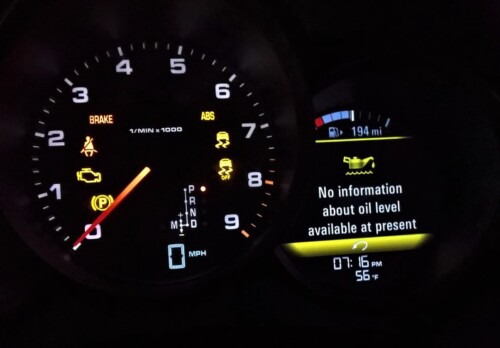 Symptoms: Warning Message Oil Level Too Low or High
If you experience an oil-level-too-high or oil-level-too-low message, be careful. The early 955 and 957 Cayennes do have an engine-oil dipstick, so you can check the level manually. Later 958 and 9Y0 models rely primarily on electronic measurement, which is a brilliant idea — assuming the electronic measurement is accurate or at the very least telling you the truth! On those cars, you need to follow the correct model-specific procedure before deciding the sensor is faulty.
You have to be sure whether the engine is actually overfilled or underfilled before taking action. On an early Cayenne, start with the dipstick and the specified measuring conditions. On later cars, repeat the electronic measurement correctly and check for relevant sensor faults. If the reading remains impossible or contradictory, a workshop may need to verify the oil quantity during a controlled drain and refill. We’ve experienced an oil reading that went down when we added a quart! Don’t assume the sensor is telling the truth, but equally don’t ignore a genuine oil-level warning.
Oil Top Off
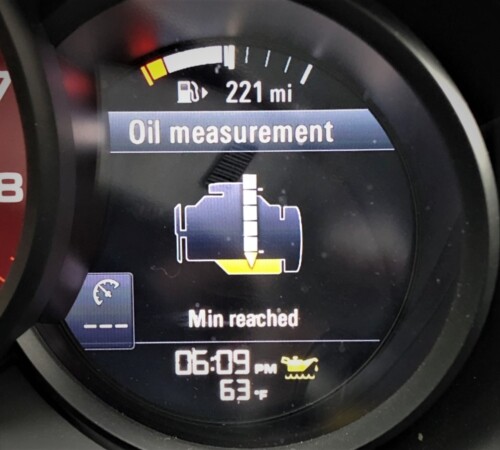 The Porsche engines will naturally consume oil while you drive. Different driving styles and conditions will cause oil consumption to change. With the extended mileage between oil changes that manufacturers have opted for, it’s very likely the car will call for additional oil between scheduled service intervals. Most independent shops consider the extended mileage range between oil changes too extreme and simply a marketing gimmick.
If your Cayenne calls for additional oil, here’s what to do:
- Use the oil grade and approval specified for your exact engine and model year.
- Check the level using the correct procedure: early cars use a warm-engine dipstick check; later electronic systems have specific temperature, parking and engine-off requirements.
- The MIN-to-MAX range is not the same for every generation: it is about 1.5 litres on many 955/957 dipsticks and about 1 litre on a 2011 958 V6.
- Add oil in small quantities, typically no more than 0.5 litre at a time, and avoid filling to or beyond MAX unnecessarily.
- Recheck the level under the prescribed conditions after each addition. Do not assume an immediate reading is valid.
- If the reading is unavailable or makes no sense, don’t keep adding oil — investigate the measurement or have the actual level checked.
Cylinder Bore Scoring
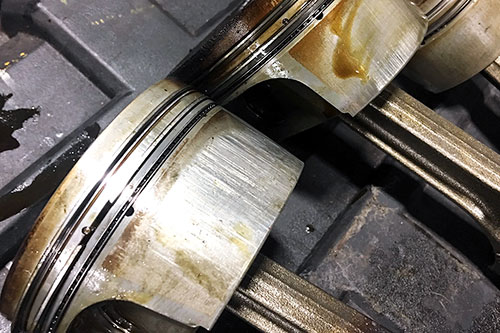
The early Cayenne V8 engines, particularly the 4.5L and some 4.8L versions, can suffer from cylinder bore scoring — deep gouges in the cylinder wall that can be associated with piston slap, increasing oil consumption and, in severe cases, engine failure. The precise cause varies and is still debated. Breakdown of the oil film, piston-to-cylinder clearance and damage to the cylinder surface may all play a part.
As wear progresses, the piston can move excessively in the bore and damage the cylinder wall further. The important thing is to confirm the condition rather than assuming every knock is caused by scoring. An early sign can be one exhaust tailpipe becoming sootier than the other, together with increased oil consumption or a knocking noise from one bank. However, none of these signs proves the engine has scored bores. A properly performed borescope inspection, supported by the symptoms and any compression or leak-down results, is the sensible next step.
An individual Porsche specialist workshop case reported in October 2026 illustrates why it pays to prove the problem before pulling the engine apart. A Cayenne arrived with knocking and misfire symptoms, and a timing-chain problem was among the possibilities considered. Once dismantled, the chain was not the cause; cylinder-wall scoring was identified instead. This is one workshop case rather than evidence of how often scoring occurs, but it reinforces the point: a knock or misfire is a symptom, not a diagnosis. The right tests come before a chain replacement or an engine rebuild.
High Oil Consumption
High oil consumption can affect some Cayenne engines, but the cause needs to be identified rather than assuming the engine itself is worn out. An engine using a quart every 1,000 miles deserves investigation, particularly if consumption is increasing. Check for external leaks, a failing PCV system, turbocharger oil leaks where applicable, and cylinder or piston-ring wear. Heavy soot or smoke may be clues, but the average fuel-consumption display is not a reliable test for engine-oil consumption. Monitor the actual quantity of oil used over a measured distance.
Switching to a renewable oil may help with oil consumption. A fresh oil change using the correct Porsche-approved specification and viscosity is a sensible first step if the service history is uncertain. However, changing oil will not repair worn rings, damaged cylinder walls or a failed PCV system. Don’t assume a different oil — renewable or otherwise — will solve excessive consumption without diagnosing the cause.
Starter Motor Failure - no crank
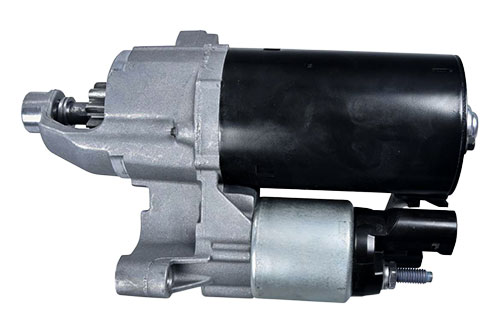
Some later Cayenne models feature an automatic start/stop system for fuel saving. In stop-and-go traffic this can contribute to better fuel economy. It can also be rather annoying and many people turn it off! Frequent stop/start cycles place extra demands on the starting system, although the components are designed for that duty and it would be wrong to assume start/stop is the cause of every starter failure.
A failed starter can cause a no-crank condition, but a weak battery, poor earth connection, starter relay or other starting-system fault can produce similar symptoms. Test the battery and starting circuit before condemning the starter motor.
Engine Cooling System
Coolant Pipes - Water Pump - Thermostat
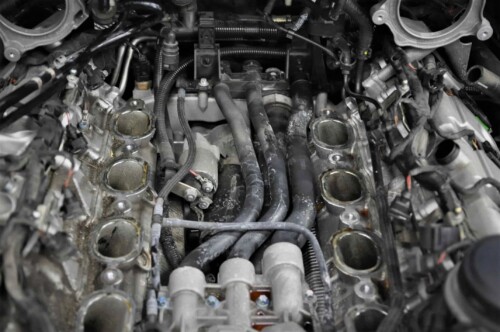
Symptoms: Coolant Leaks – Steam From Under The Hood – Engine Overheating
A coolant leak can be deadly for any engine, especially in the Porsche Cayenne. Driving with insufficient coolant can overheat the engine very quickly, causing severe damage and potentially requiring a complete engine replacement. The coolant pipe failure in the early Cayenne typically happened quickly and produced large amounts of steam from under the hood.
The early 4.5L V8 Cayenne S and Turbo engines, particularly the 2003–2006 955 models, featured a series of plastic coolant pipes that ran through the valley of the engine directly beneath the intake manifold.
Running plastic coolant pipes underneath the intake manifold seems like a reasonable idea, until you realize how years of heat cycling and ageing can make those pipes brittle and prone to cracking or splitting. Once they degrade, a small leak can rapidly become a major coolant loss, sometimes producing large clouds of steam from under the hood while the engine is running – steam-powered Cayenne!
Water Pump Failure
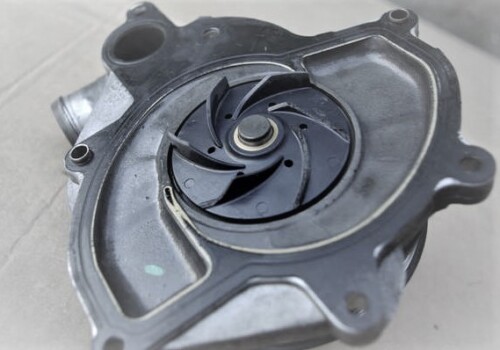
Water pumps and thermostats are familiar failure points as Cayennes age, although the problems and access vary by engine and generation. The water-pump shaft bearing can wear, allowing play in the shaft and, in more serious cases, a rumbling or grinding noise. More commonly, owners first notice a coolant leak from the pump seal or weep area at the front of the engine. A damaged impeller or loss of pump circulation can also cause overheating. Depending on the fault, the temperature may climb at idle or in traffic and settle when the car is moving. However, a failing pump can also cause overheating under load, so don’t rely on that pattern alone to diagnose it.
On some earlier V8 Cayennes, the water pump is relatively accessible at the front of the engine. On later V6 and V8 models, the location and the work involved can be quite different, so don’t assume the same repair procedure or labor time applies to every Cayenne.
There is also a useful Porsche technical update for some 2018–2023 9Y0 Cayennes. If a coolant-pump fault or leak is diagnosed on the specified V6 Turbo or 4.0L V8 biturbo engines, Porsche says the coolant-pump change-over valve must also be checked. Replacing a pump without checking the valve could miss an underlying cause of the failure
Thermostat Failure – Overheating
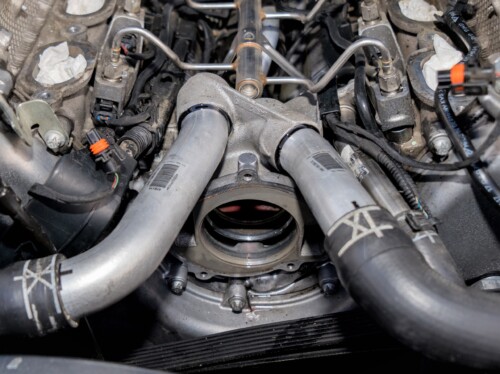 The thermostat arrangement varies between Cayenne engines. Some use a conventional mechanical thermostat, while others have electronically influenced cooling control. A thermostat can fail without producing a clear thermostat-specific fault code. A thermostat stuck open is usually less urgent because the engine runs too cold, although warm-up, fuel consumption and emissions can all suffer. A thermostat stuck closed is a different story – the engine can overheat rapidly, and continued driving may cause serious damage.
Where the thermostat and water pump share significant labor and both are old, it often makes sense to replace them together. However, this isn’t necessary on every Cayenne engine – confirm the actual failure and repair access first. If coolant has leaked onto the front of the engine, it’s also important to inspect the drive belt and tensioner for contamination or damage, replacing affected components where necessary.
Not addressing these issues promptly can cause local hot spots, cylinder-head or head-gasket damage and, in the worst cases, complete engine failure.
Coolant Expansion Tank Cracks – Low Coolant Level – 955 / 957
Symptoms: Low Coolant Warning, Sweet Coolant Smell, Intermittent Puddle, Coolant Leaking Near Expansion Tank
The early Cayenne has plenty of places where coolant can escape, so when the level starts dropping the natural assumption is that one of the famous engine coolant pipes has finally given up. Sometimes it is something rather simpler. The plastic coolant expansion tank can develop a small crack in the body, along a seam or around one of its connections as the car gets older. The pressure cap and its sealing surfaces also deserve attention.
These leaks can be frustrating because they do not necessarily appear while the car is sitting cold on the driveway. As the system heats up, the pressure increases and the crack can open enough to allow coolant to escape. By the time the car is in the shop and the engine has cooled, the evidence may be little more than some dried coolant residue. Owners report the level dropping gradually, an occasional puddle and a smell of coolant after a drive.
Before taking the intake manifold off to investigate engine pipes, have a good look at the tank, its seams, the neck and the cap. A professional pressure test, including testing the cap at the correct specification, can often identify a problem that a visual inspection misses. If the tank is cracked, replacement is the proper answer. Don’t start gluing an old pressurized coolant container together and hoping for the best! The important point is to identify the source of the leak before committing to the more expensive repairs.
Coolant Leaking Into the Vacuum System – Water Pump – 9Y0
Symptoms: Slowly Falling Coolant Level, Coolant Around Water Pump, Coolant Temperature Too High Warning, Possible Vacuum System Faults – Later V6 and V8 Cayenne
On the later 9Y0 Cayenne there is a cooling-system problem that is worth understanding before replacing a water pump and declaring the job finished. On applicable V6 and 4.0L V8 engines the pump has a vacuum-operated sleeve that can alter coolant circulation during warm-up. Porsche uses a change-over valve to control this arrangement. When the pump or its associated sealing and valve system fails, coolant may also make its way into connected vacuum lines. That can turn what looks like a straightforward coolant leak into a more involved repair.
Porsche has published workshop guidance for 2019–2021 Cayennes that specifically calls for inspecting the water pump, replacing the relevant change-over valve when the documented temperature-warning condition applies, and checking vacuum lines for damage or residue. The important symptom is a “Coolant temperature too high” message, sometimes accompanied by instrument-cluster fault B19A750. Other versions of the Porsche procedure also cover pump leakage on specified 2018–2023 engines. The exact procedure depends on the model and fault pattern, so a failed valve test and an actual over-temperature event are not interchangeable.
Independent workshops and detailed owner reports have also documented coolant in the vacuum line at the pump. The resulting investigation can involve checking the vacuum switching valves and connected circuits, not simply bolting on another water pump. We would want to know whether the shop has inspected the lines for traces of coolant before approving a substantial bill. Equally, do not assume that every pump leak has contaminated the entire vacuum system. The extent of the damage must be established on the individual car.
Be particularly wary of internet suggestions to bypass the vacuum control as a permanent solution. Altering the factory cooling arrangement may affect warm-up behavior and other systems. If the car reports a genuine over-temperature warning, stop safely and switch off the engine rather than driving on to see if the message disappears.
Coolant Loss – Coolant Regulator Seal – 2023 Cayenne E-Hybrid
Symptoms: Gradual Coolant Loss, Yellow or Red Coolant Level Warning – Selected 2023 Cayenne E-Hybrid Models
A slowly falling coolant level on a comparatively new Cayenne is not something you should simply accept. Porsche identified a production issue affecting a limited group of 2023 Cayenne E-Hybrid and E-Hybrid Coupé models in which the radial shaft seal in the coolant regulator did not meet specification. Coolant can gradually escape from the regulator, eventually producing a warning as the level in the expansion tank drops.
Porsche workshop campaign WRK2 (Technical Information 106/24) specifies replacement of the complete coolant regulator housing on an affected vehicle. That is an important distinction: the regulator is integrated into its housing and is not replaced separately under the published procedure. The repair should be checked against the vehicle’s campaign record before the owner pays for what appears to be an ordinary cooling-system leak.
This is not a recall affecting every 2023 Cayenne, and it is not evidence that all E-Hybrid regulators fail. The factory procedure is for VINs assigned to WRK2. If your 2023 E-Hybrid keeps asking for coolant, have the shop check the VIN and inspect the correct regulator assembly before starting a more general parts-replacement exercise. A real coolant warning still needs to be taken seriously, regardless of whether the car is included in the campaign.
Continual Coolant Leaks - Front & Rear Engine - 957 4.8L V8
Symptoms: Loss of Coolant, Flashing Coolant Light
The 957 Cayenne 4.8L V8 has several coolant pipe connections bonded into aluminum housings – great idea! On some engines, the adhesive bond eventually deteriorates and a connector starts to loosen or leak. The two areas worth checking are the front thermostat housing and the coolant crossover/distribution pipe at the back of the engine, close to the bellhousing.
Front Engine Coolant Leak
The leak at the front of the engine is most likely from the upper front coolant pipe, which slips out of its housing when the glue fails. Porsche revised the replacement thermostat housing to use threaded or mechanically secured pipe connections rather than the original bonded design. This removes the original adhesive-joint weakness, although seals and other coolant connections can still leak. This is a known issue on the 957 4.8L V8, but the cost depends on the parts required and the labor involved. If you’re buying one, check the service history rather than assuming the updated housing has already been installed. One workshop detail worth knowing: Porsche has warned that the revised thermostat housing can require an intake-distributor clearance check during installation. Fitment matters – this isn’t simply a matter of bolting on the updated part.
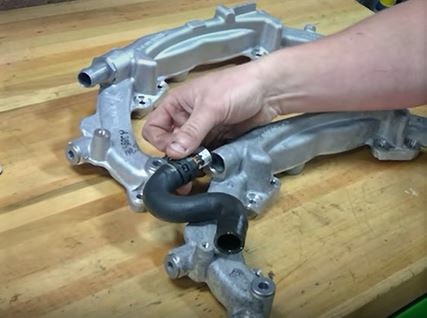 Rear Engine Coolant Leak
The leak at the rear of the engine is much more of an issue. Some 957 Cayenne 4.8L V8 engines develop a leak at a coolant-hose connector on the rear crossover pipe, close to the firewall. It’s a well-known weak point, but it does not affect every Cayenne V8. You may get a low-coolant warning and see coolant collecting under the middle of the car, often just behind the front wheels. A large leak can empty the system quickly, so don’t continue driving.
Leaking Coolant Tube Inserts
The rubber cooling hose is clamped to an aluminum insert that sits in the housing that distributes coolant between the two cylinder heads. The glue fails on the aluminum insert and coolant leaks out. Porsche’s revised coolant distribution assembly uses a threaded hose connection rather than the original bonded insert. The conventional repair is replacement of the affected distribution assembly, although a specialist should inspect the exact failure and available repair procedure before ordering parts.
Replacing the Coolant Distribution Tube
Earlier 2011 Cayenne S Hybrid – thermostat fails closed
On an early 2011 Cayenne S Hybrid with engine code M06.EC, Porsche published specific information about a coolant regulator whose expansion element could crack and stop the thermostat opening. The engine overheats and displays “Engine temperature too high”, yet no thermostat-specific DME fault is stored. Porsche identifies a modified version introduced from 19 November 2010. If an early-build Hybrid develops genuine overheating, confirm the engine code and production date before assuming the absence of a thermostat code rules it out.
Coolant Vent and Bleed Pipe Leaks – 958 V8 and 3.6L Twin-Turbo
Symptoms: Gradual Coolant Loss, Sweet Smell After Driving, Dried Coolant in the Engine Valley, Coolant Running Down the Back of the Engine – 958
Not every coolant leak in the engine valley is the old 955 plastic-pipe problem or the familiar 957 bonded rear fitting. The 958-generation V8 engines also have smaller vent and bleed connections that can become brittle or begin leaking with age. On the later 958.2 Cayenne S and GTS with the 3.6L twin-turbo V6, owners and workshops have reported a leaking coolant bleed tube that can be particularly awkward to identify.
The leak may begin as an occasional need to top up the reservoir with no obvious puddle. As it develops, coolant can collect in the valley below the intake and run down the back of the engine or bellhousing. Naturally, the puddle ends up a long way from the component that is actually leaking. An ordinary cold pressure test may not immediately reproduce a very small intermittent leak, particularly if the engine has been cooling down for some time.
The sensible approach is to remove enough covers to inspect the actual pipes, hose joints and dried coolant deposits, then pressure-test and inspect again as the Porsche workshop procedure requires. Some jobs involve removing the intake to see the failing connection properly. While the area is apart, it is worth inspecting nearby seals and aged hoses, but that does not automatically mean every pipe, thermostat and water pump needs replacing. The V8 and 3.6L twin-turbo versions use different cooling arrangements, so identify the engine and leak source before ordering a collection of parts. A good Porsche specialist will know the difference.
Active Cooling Flap Failure - dashboard message - overheating
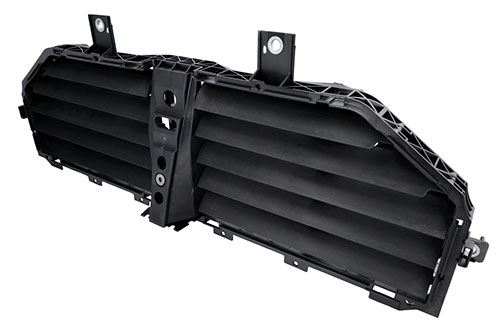 Some later Cayenne models, including equipped 958-generation and 9Y0 vehicles, have active cooling flaps. These are small electronically controlled shutters in the front grille that open or close to improve aerodynamics, engine warm-up times, fuel efficiency, and cooling efficiency. If a flap sticks or its actuator fails, the engine management system may store faults such as P05A0 or P05A3 and illuminate the check engine light. Flaps stuck closed can restrict cooling air and contribute to overheating; flaps stuck open more commonly affect warm-up and efficiency.
Symptoms can include a check engine light, an active-flap fault code or higher-than-normal engine temperature if the shutters are stuck closed. Cooling fans may run more often, but fan operation alone does not prove the shutters are faulty.
The typical causes are:
- Faulty actuator motor
- Stuck flap due to debris, corrosion, or ice
- Broken plastic flap hinges
Before replacing the flap assembly, check for leaves, stones, ice or other debris, inspect the motor and wiring, and use PIWIS to command the flaps open and closed. Don’t condemn the actuator simply because a code has been stored.
Red Coolant Warning – Reservoir Level Correct – Cayenne Hybrid
Symptoms: Red “Check Coolant Level” Message, Flashing Temperature Display, Temperature Gauge at Maximum – 2013–2015 Cayenne S Hybrid / S E-Hybrid
A red coolant warning accompanied by a temperature gauge sitting at maximum is understandably alarming. Quite right too — a genuinely overheating engine can be damaged very quickly. However, Porsche documented a rather different cause for this particular combination on certain 2013–2015 Cayenne S Hybrid and S E-Hybrid models, even when the coolant level in the reservoir is correct.
The fault can be caused by poor electrical contact at the coolant-level sensor connector in the low-temperature cooling circuit. The resistance in the sensor wiring changes enough to make the control system report a coolant problem. Porsche also explains that the temperature display is deliberately driven to maximum when the cooling-system fault warning is triggered. In this specific situation the indicated maximum temperature does not, by itself, prove that the engine coolant is actually overheating.
Porsche Technical Information 22/15 describes repairing the connector contacts and coding the rear-end electronics with PIWIS. It specifically warns that replacing the coolant regulator will not solve this fault. Of course, the first job is to establish the real coolant level and temperature safely – you should never continue driving in the hope that a red warning is false. But once a specialist has confirmed the particular vehicle, production date and symptom pattern, this could be a substantially simpler electrical repair than replacing pumps, thermostats or other cooling hardware.
Hybrid e-machine cooling faults
On some Cayenne S E-Hybrid 92A models, a red hybrid-system warning together with high-voltage power-electronics temperature faults can originate in a coolant hose with an integral thermostat. Porsche documented cases where this thermostat sticks, leading to temperature-related e-machine faults. The specified codes and coolant-circuit diagnosis need to match before the hose is condemned; this is not the same problem as an overheating V6 combustion engine or the 12-volt/contactors issue already covered elsewhere in the Hybrid section.
Hybrid System Problems
Main Battery Degradation and Failure
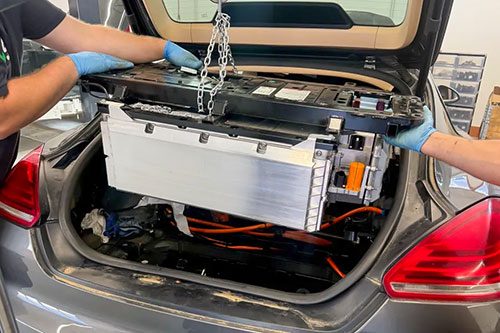 The Cayenne hybrid models use different battery technologies, and it is important not to treat them all the same. The original 2011–2014 Cayenne S Hybrid is a conventional hybrid, not a plug-in, and was designed for only short bursts of electric-only driving. The later Cayenne S E-Hybrid and 9Y0 E-Hybrid models can be charged externally, but their electric range varies considerably by model year, battery size, temperature and how the car is driven. For example, the 2015 Cayenne S E-Hybrid was EPA-rated at 14 miles of electric driving when new — not 18–20 miles. A falling range estimate does not, by itself, prove the high-voltage battery is worn out.
The high-voltage battery can be an expensive component to repair or replace, so a proper diagnosis is essential before anyone condemns it. Porsche provides specific high-voltage battery warranty coverage, but the terms depend on the model year and market. For example, the 2025 US E-Hybrid warranty covers defects in the high-voltage battery for 8 years or 100,000 miles, subject to its conditions. Ordinary ageing and a reduction in estimated electric range are not automatically covered faults. Ask a qualified Porsche hybrid specialist to check the actual battery measurements, stored faults, thermal management and charging performance before accepting a recommendation to replace the complete battery. The repair could involve a related component, control electronics or software rather than the battery pack itself.
If a high-voltage battery fault is actually confirmed, ask whether the repair has to involve the complete pack. Porsche has published procedures for replacing individual cell modules or control components on certain Cayenne E-Hybrids, although the permitted repair depends on the vehicle, market and workshop authorization. On some 2019–2020 9Y0 models, updated 37 Ah cell modules also require matching battery-management software. The important thing is that the diagnosis, replacement parts and coding belong together — not that a complete battery is automatically the only option.
High-Voltage Battery Controller — 20-Year Warranty Extension – 958
Symptoms: Hybrid System Failure, Battery Controller Faults, Expensive High-Voltage Battery Diagnosis — 2015–2018 Cayenne S E-Hybrid
If you own a 2015–2018 Cayenne S E-Hybrid and somebody tells you that the high-voltage battery control unit needs replacing, there is something you should check before reaching for your wallet. Porsche extended the warranty on this particular control unit to 20 years from the original new-vehicle delivery date, with no mileage limit, for vehicles in the United States, Canada and Puerto Rico. The coverage transfers automatically to subsequent owners.
This is an important distinction. The extension covers the high-voltage battery control unit, identified by Porsche as part-ID 2794. It does NOT automatically give the complete high-voltage battery, coolant pumps, contactors or associated wiring the same 20-year coverage. That matters because the words “hybrid battery fault” can cover several completely different parts, with very different repair costs.
Before authorizing a repair, ask the shop or Porsche Center to establish exactly which component is faulty and check the VIN in Porsche’s Central Service System (PCSS). The additional warranty scope should be shown against the vehicle. Normal warranty conditions and exclusions still apply. A proper diagnosis and a quick coverage check could save you a very expensive mistake.
Check Engine Light — Hybrid Battery Coolant Pump Fault P0C4700 – 958
Symptoms: Check Engine Light, P0C4700 in High-Voltage Battery Control Unit, Sometimes No Other Obvious Symptoms
A check engine light on an early Cayenne E-Hybrid can lead to some expensive conclusions, particularly when the scan identifies a coolant-pump fault in the high-voltage battery system. However, Porsche has documented a much more ordinary set of causes for code P0C4700 on the 2015–2017 Cayenne S E-Hybrid — poor grounds, corrosion and damaged electrical connections.
The additional low-temperature coolant pump is part of the hybrid cooling arrangement. If its electrical circuit is interrupted, the battery control unit can report P0C4700. Porsche’s updated technical information directs technicians to inspect ground point 6B, the pump connector and the wiring for corrosion, poor connections and continuity problems. A painted or corroded ground bolt can be enough to spoil the electrical connection. Not exactly the sort of thing you want to discover AFTER fitting several expensive parts!
If the electrical checks pass, Porsche’s procedure goes on to replace the auxiliary coolant pump and its relay. The order of those tests is the important part — prove power, ground and continuity before assuming the pump has failed. The fault code alone does not justify replacing the complete hybrid battery or battery control unit.
This bulletin is specifically for the earlier 92A system. Later 2024–2026 E-Hybrids can report the same P0C4700 code for a different control-unit problem, described separately below. Same code, different car and potentially a very different repair.
Plug-In Charging Problems and Reduced Electric Range – Cayenne E-Hybrid
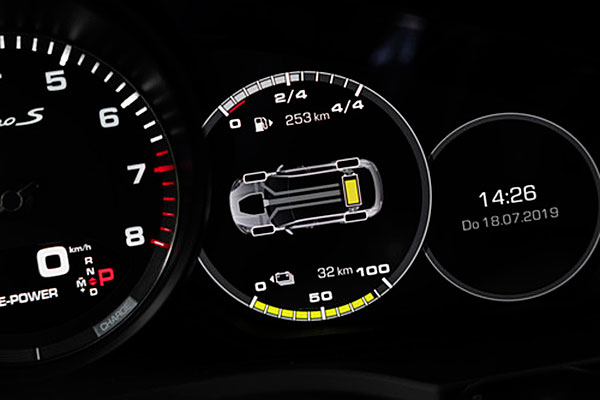
If your Cayenne E-Hybrid will not charge, charges intermittently, or stops charging before completion, don’t immediately assume that the main hybrid battery has failed. Start with the obvious things: charging schedule and settings, the charging cable, supply socket or wall unit, and whether the same fault occurs on another suitable charging source. The onboard charging electronics, vehicle charge port, wiring, cooling system and high-voltage control units can all be involved, so the exact fault codes and charging conditions matter.
A Cayenne that charges normally but shows a disappointing electric range is a different diagnostic problem. Cold weather, cabin heating, driving style, recent journeys and battery condition all change the distance shown on the dashboard. Compare actual driving performance under similar conditions and have the battery and thermal-management data checked before deciding the pack is worn out.
Scheduled Charging Does Not Start — But Direct Charging Works
Several Cayenne E-Hybrid owners have described a frustrating situation where the car charges perfectly well when direct charging is selected, but fails to start or complete a scheduled overnight charge. That is not the same symptom as a car which cannot charge at all. Before replacing a charge port, charger or battery, try to establish whether the problem follows the departure timer, My Porsche app settings, home energy-management schedule or a particular charging station.
Record the requested departure time, the actual start and stop times, the car’s charge status and any messages in both the vehicle and the charging app. Try a supervised direct-charge test on a suitable alternative charger, and ask the Porsche Center to check available software updates and vehicle logs.
Plug-In Charging Stops — Battery-Cooling Pump Control Fault – 9Y0
Symptoms: Vehicle Will Not Charge, Charging Aborts, Check Engine Light, Fault P0C4700 — 2024–2026 Cayenne E-Hybrid
The Cayenne E-Hybrid has to control the temperature of its high-voltage battery while it is charging. If the battery-cooling system cannot be operated correctly, the car may refuse to start charging or stop part-way through the process. That can look like a failed charger or even a failing battery, but Porsche has identified a more specific possibility on some 2024–2026 cars.
Porsche Technical Information 120/25 describes a loose pin within the high-voltage battery 2.0 control unit. This can interrupt the control signal to the additional coolant pump in the low-temperature cooling circuit, preventing the battery from being cooled as intended during charging. The associated code is P0C4700 — “Additional coolant pump, activation, open circuit”.
The workshop procedure starts by using PIWIS to operate and check the additional pump and then tests the relevant signal line. If those tests establish the documented control-unit fault, Porsche directs replacement of the high-voltage battery control unit. The pump itself is not automatically the failed component, and neither is the high-voltage battery pack.
If your later E-Hybrid repeatedly aborts charging and this code is present, ask what testing was performed on the pump circuit before approving expensive hardware. On these vehicles a charging fault may be a control-signal problem rather than a problem with the electricity supply. As always, high-voltage diagnosis belongs with a properly trained and equipped Porsche technician.
Hybrid Power Electronics Faults – Warning Messages and Reduced Hybrid Operation
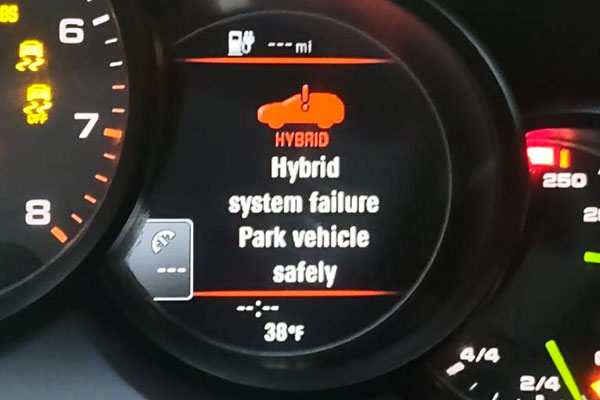 The Cayenne hybrid system relies on high-voltage power electronics to control electrical power between the battery and electric drive. A fault in this system can produce hybrid warnings, reduced electric operation or other drivetrain symptoms. However, those symptoms do not automatically mean the power electronics have failed. Battery condition, cooling, high-voltage connections, control-unit communication and software problems can produce similar complaints.
These components are expensive enough without replacing the wrong one! A qualified Porsche hybrid specialist should read the complete vehicle fault history, check the applicable technical information and campaigns, and prove the cause before ordering hardware. Depending on the fault, Porsche may specify a software update or guided test procedure rather than replacement. Where a control unit really has failed, the repair needs the correct high-voltage safety procedures and Porsche diagnostic programming.
Charging Cable Overheating — APB6 Safety Recall – 9Y0
Symptoms: Hot 240V Charging Plug or Socket, Discoloration, Burning Smell, Portable Charger Recall — Certain 2019–2024 E-Hybrids
Not every charging problem is inside the Cayenne. Porsche recalled certain 240-volt supply cables supplied with the Porsche Mobile Charger because, under some conditions, the plug and household socket can become excessively hot. Increased electrical resistance can damage the socket and surrounding material, with a potential fire risk. This is recall APB6, listed by NHTSA as 23V-841.
The important point is that this recall concerns the portable charging equipment and its supply cable, not proof that the Cayenne’s high-voltage battery is defective. Porsche’s repair procedure depends on the charger and campaign scope. It may include a revised cable with temperature monitoring, charger software updates or, in some cases, replacement of charging equipment.
If your vehicle or Porsche Mobile Charger is affected, follow the current Porsche instructions and do not continue using the recalled 240V cable until the required remedy is completed. A hot plug, damaged outlet or burning smell is not something to experiment with. Check the VIN and charger details with a Porsche Center; an electrician should assess any damaged home socket or wiring.
Owners of used E-Hybrids should also check that the correct charging cable was supplied with the vehicle and that any outstanding APB6 remedy has been completed. An ordinary vehicle recall lookup is important, but the charger identification may matter as well.
Battery Management System (BMS) Errors
The battery management system monitors the high-voltage battery, including individual cell-group voltages, temperature, state of charge and protection limits. If it detects a value outside the expected range, it can restrict charging or electric operation and display a hybrid-system warning. Sometimes this points to a genuine battery problem; in other cases the cause can be a sensor, connection, temperature-control issue or software fault. It is a mistake to assume that every BMS fault means the battery needs replacing — or that the warning is probably erroneous.
The sensible approach is to read the full high-voltage fault memory and the battery measurement data with PIWIS, then follow the test plan for the exact codes. A technician trained and equipped for high-voltage systems should determine whether the problem lies in the battery, its controls or a related system. Some repairs are expensive, but there is no benefit in starting with the most expensive component!
Battery Cooling — Air Conditioning Pressure Sensor Fault – 9Y0
Symptoms: Air Conditioning or Battery Cooling Problems, High-Voltage Battery Temperature Concerns — Selected 2020–2023 Cayenne E-Hybrids
The air conditioning system in an E-Hybrid does more than keep the occupants comfortable. It also plays a part in controlling the temperature of the high-voltage battery, so an air conditioning fault can become a hybrid-system issue under the wrong conditions.
Porsche’s WPS1 campaign identifies certain refrigerant-circuit pressure sensors that were not manufactured to the required specification on selected 2020–2023 Cayenne E-Hybrid models. If one or both sensors fail, the air conditioning and battery cooling may not operate correctly, potentially allowing the high-voltage battery temperature to rise.
The prescribed action is to check the pressure sensors and replace them where required. It is a VIN-assigned workshop campaign — not evidence that every Cayenne E-Hybrid has defective cooling sensors. A qualified shop should check PCSS, confirm the specific sensor versions and investigate the refrigerant and battery-temperature readings before deciding on the repair.
If you are told the hybrid battery is overheating, it is worth asking whether the refrigerant-pressure signals and the relevant campaign have been checked. Condemning the main battery because a related temperature-management component is reporting nonsense would be a costly way of solving the wrong problem.
Hybrid System Warning — Engine Will Not Restart from Start/Stop – 958
Symptoms: Red Hybrid System Failure or Yellow Hybrid Fault, Engine Does Not Restart from Start/Stop, P0A1B00 – 2015–2018 Cayenne S E-Hybrid
A red or yellow hybrid warning on a Cayenne E-Hybrid is not always caused by an expensive failure of the high-voltage hardware. Porsche documented a software problem on 2015–2018 Cayenne S E-Hybrids that can stop the combustion engine restarting correctly from Start/Stop mode. The driver may find that the car will not resume normal operation until the ignition has been switched off and back on.
Porsche Technical Information 66/19 identifies fault P0A1B00 in the high-voltage power electronics control unit. A heavily discharged high-voltage battery can make this particular software fault more likely. Porsche’s repair, where the specified fault and older software version are present, is to update the high-voltage power electronics control unit rather than replace it.
Of course, cycling the ignition and making the warning disappear does not establish that the underlying problem has been repaired. Nor should you ignore a red warning that instructs you to stop. Have the fault history and software version checked with PIWIS and follow Porsche’s current test plan. The fault-code pattern is what separates this relatively straightforward software solution from a real contactor, pump or battery problem.
Red Hybrid-System Failure – Rear Clicking – Weak 12V Battery
Symptoms: Red Hybrid Failure Warning, Clicking from Rear of Vehicle When Parked – 2015–2018 Cayenne E-Hybrid
A red hybrid-system failure warning on a Cayenne E-Hybrid can look like the beginning of a very expensive repair. If the diagnostic codes point towards the high-voltage contactors, it’s understandable that owners immediately worry about the high-voltage battery or its control electronics. Porsche has now clarified an important and often less expensive starting point — the condition of the ordinary 12-volt battery.
On the 2015–2018 Cayenne E-Hybrid, Porsche identifies a pattern where an aged 12V battery causes the high-voltage contactors to cycle repeatedly while the vehicle is parked. Owners may hear a clicking noise from the rear of the car, and fault codes such as P0AA100, P0AA200, P0AA400, P0AA500 or P0AE300 may appear. Continued cycling can eventually damage the E-box contactors or associated control hardware, so ignoring a weak battery can turn a manageable problem into something rather more serious.
The revised Porsche procedure starts by reading the battery ageing data with PIWIS. If the relevant PIWIS battery-ageing measurement is below 60%, Porsche directs replacement of the 12V battery, clearing of the faults and a repeat system test before moving on to the E-box and high-voltage battery control unit. That order matters. It can prevent an unnecessary high-voltage repair, although a healthy new 12V battery will not cure contactors that have already been damaged. If the vehicle displays a red hybrid-system failure warning or tells you to park safely, follow the warning, stop in a safe location and arrange qualified hybrid-system diagnosis. Never attempt to disconnect, open or repair the high-voltage components yourself.
PSM Failed Warning — Changed Brake Pedal Feel – 9Y0 E-Hybrid
Symptoms: Yellow PSM Failed Message, Unusually Long Brake Pedal Travel, P05FF00 — Selected 2019–2023 Cayenne E-Hybrids
A yellow “PSM failed” warning on an E-Hybrid may sound like a conventional stability-control fault. However, there is a Porsche campaign for certain 2019–2023 Cayenne E-Hybrids that involves the software in BOTH the high-voltage power electronics and the Porsche Stability Management (PSM) control unit. In the relevant fault condition, drivers may also notice a change in brake pedal feel, including a longer pedal stroke than normal.
Porsche identifies fault P05FF00 and specifies reprogramming both control units under campaign WSC7. That is rather different from ordering an ABS/PSM module on the strength of the warning light alone. The exact codes and VIN campaign status should be checked before parts are fitted.
A change in brake pedal travel or braking performance must be taken seriously. Do not assume the car is safe to drive because Porsche has published a software remedy for SOME examples of this warning. If the brake pedal is unusually long or the car is not braking as expected, stop safely and arrange professional inspection. Once the vehicle is safe, a Porsche specialist can confirm whether WSC7 applies and whether a genuine hydraulic or mechanical brake fault also needs attention.
Red Stop Vehicle Safely Warning — Hybrid Battery Software – 2025 models
Symptoms: Red Park/Stop Vehicle Safely Message, High-Voltage System Warning — Certain 2025 Cayenne E-Hybrids
A red warning instructing you to park or stop the Cayenne safely sounds like the beginning of a very expensive hybrid repair. On some 2025 E-Hybrid models, however, Porsche identified a software fault in the high-voltage battery control system that could trigger this warning under certain conditions.
Porsche workshop campaign WSE2 directs dealers to update the high-voltage battery and high-voltage E-box control units on the vehicles assigned to the campaign. This is a software remedy, not a general instruction to replace the battery or open up the E-box. Porsche temporarily paused part of the original rollout while correcting the programming process, so the shop should verify the CURRENT campaign status and required PIWIS software rather than rely on an old printout.
That does not mean every red hybrid warning on a 2025 Cayenne is a software glitch. Follow the vehicle’s stop instruction, arrange safe diagnosis and have the VIN checked in PCSS. If the campaign applies, completing the prescribed programming may resolve the documented condition without replacing expensive hybrid hardware.
Exhaust
Exhaust Rattle – Catalytic Converter Damage and Inefficiency Faults
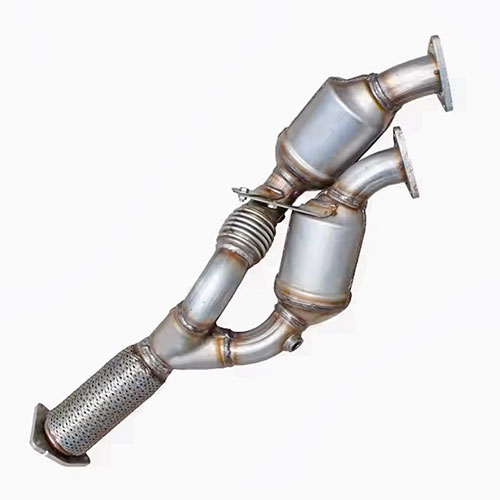 Symptoms: Exhaust Rattle Under Acceleration, Check Engine Light, Exhaust Leak or Loss of Power
As older Cayenne models accumulate mileage, we do see damaged catalytic converters, broken exhaust sections and failures around the front pipes, flex joints or welded connections. However, a rattle from under the vehicle does not automatically mean the catalyst or muffler has failed; an exhaust leak, heat shield or exhaust-flap mechanism can sound remarkably similar.
One sign of a converter breaking apart internally can be a metallic rattle, often most noticeable as engine speed changes. The same noise can also come from a loose heat shield, pipework or an exhaust flap, so the source needs to be identified before anything expensive is ordered. While annoying, it’s also potentially destructive – a collapsed converter core can restrict exhaust flow, rob the engine of power and create extreme exhaust temperatures. Seeing a catalytic converter glowing bright orange under a Cayenne is quite disconcerting — and a good reason to stop driving rather than see how far you can get!
failing catalyst may set a check engine light with converter-efficiency faults such as P0420 or P0430. However, those codes do not prove that the converter has physically disintegrated: exhaust leaks, oxygen-sensor response, fuel-mixture problems and misfires must be checked before condemning the catalyst. An active emissions fault can also prevent the vehicle from passing a state inspection where OBD emissions checks apply. Whether the vehicle can legally be registered or driven depends on the state and the nature of the defect.
Exhaust Rattle – Failed Exhaust Flap Actuator – 9Y0
SYMPTOMS: Rattle or metallic chatter from the rear exhaust, sometimes a check engine light – 2019-on Cayenne 9YA/9YB
An exhaust rattle on a later Cayenne is not always the catalytic converter breaking up. Porsche has documented a different problem on 9Y0 models — the electric actuators that control the exhaust flaps at the rear of the car can fail, or the flap mechanism itself can become loose or obstructed. The result may be a metallic rattle at idle or when the exhaust note changes. It can sound rather dramatic, especially when the car is otherwise running perfectly well.
Porsche technical information SY 68/21 identifies fault codes P047600 and P04A000 for implausible exhaust-flap signals. The correct diagnosis starts by locating the noise and testing the actuator, its connection and the flap mechanism. The actuator can be removed for a manual check of the flap. If the mechanism in the rear silencer has excessive play or is sticking, replacing an electric actuator alone will not solve the problem. Equally, a sound flap with a failed actuator does not automatically require a complete rear exhaust.
This is exactly where a little diagnosis saves a large bill. We’ve seen owners assume that a rattle means the catalyst has failed, while others have been quoted for an entire exhaust system when the real problem was an actuator. Have an experienced Porsche specialist reproduce the noise, read the DME faults and prove which component is causing it before authorizing an expensive replacement.
Exhaust Flap Rattle – Cayenne Turbo GT – Special Repair Procedure
SYMPTOMS: Metallic exhaust rattle, P047600 or P04A000; sometimes Engine Control Faulty or Reduced Engine Power – Cayenne Turbo GT 9YB, MY2022-on
The Cayenne Turbo GT has its own version of the exhaust-flap problem, and there is a useful detail in Porsche’s workshop instructions that a general exhaust shop could easily miss. A rattle from the rear exhaust can be associated with an actuator fault, and on some cars the dashboard may also display an engine control or reduced-power warning. That does not automatically mean the engine or catalytic converter is damaged.
For Turbo GT vehicles built up to May 9, 2023, Porsche identified the possibility of an incorrectly taught exhaust-flap actuator. If the workshop’s test plan confirms that this is the cause of the complaint, Porsche specifies replacing both exhaust-flap actuators together. On later vehicles, or where the fault is different, only the actually affected actuator is replaced. The technician must also check that the mechanical flap in the silencer moves correctly; a damaged or jammed flap is a different repair.
The production date matters more than the model year on the registration. Before buying an expensive rear exhaust or replacing individual parts repeatedly, have the shop confirm the actual fault codes, build date and Porsche’s Turbo GT-specific procedure. Replacing the wrong part three times is still the wrong repair!
Engine Power Reduced – Exhaust Flap Wiring Fault – 9Y0
SYMPTOMS: Engine Power Reduced warning, faulty exhaust-flap operation, P048E00; possibly CEL – 2019–2024 Cayenne 9YA/9YB
An engine power warning accompanied by an exhaust-valve fault sounds like the start of another expensive exhaust repair. However, Porsche has identified a specific electrical problem on certain 2019–2024 Cayennes where the actuator itself may not be the culprit at all. The wiring to the bank 1 exhaust flap can be damaged near the plug connection.
Porsche TI 19/25 describes fault P048E00 — exhaust pressure valve, short circuit to positive — together with reduced engine performance and an exhaust-flap malfunction. The instructed check is the electrical harness for the bank 1 exhaust-flap actuator, on the right-hand side in the direction of travel. A damaged connection or wiring section should be repaired before replacing the actuator or rear silencer.
The important distinction here is the exact fault code. Not every exhaust-flap warning is a harness problem, but if P048E00 is present the wiring deserves attention first. There’s little satisfaction in fitting a new exhaust only to discover that the original electrical fault is still there.
Check Engine Light – Catalytic Converter Heating Fault – Turbo GT
SYMPTOMS: Intermittent Check Engine Light, P0D8500 – 2024–2025 Cayenne Turbo GT
A check engine light with a fault description mentioning the catalytic converter is enough to make any owner nervous. On certain 2024–2025 Cayenne Turbo GT models, though, Porsche has identified a condition where the engine management software is the problem, not the catalytic converter or its heater circuit.
The specific code is P0D8500, relating to the supply voltage during catalytic-converter heating. Porsche says the overvoltage threshold stored in the DME software is too low, so a normal voltage is incorrectly interpreted as a fault. For this exact combination of vehicle, symptom and code, the prescribed repair is to update the DME using the Porsche PIWIS programming procedure. The guided process also programs the transmission control unit. Porsche explicitly states that replacing components will not solve this particular fault pattern.
Don’t confuse this with a genuine catalyst-efficiency fault, a misfire or an electrical failure elsewhere in the exhaust system. Confirm the stored code, vehicle software version and current Porsche instructions before buying parts. The most expensive catalytic converter in the world won’t fix a software threshold!
Buzzing From Exhaust on Deceleration – Cayenne S – 9Y0
SYMPTOMS: Metallic buzzing or vibration at approximately 1,100 rpm while slowing down – early Cayenne S 9YA
A metallic buzz from beneath the Cayenne while slowing down may sound like a failed catalytic converter or a loose internal exhaust component. On certain early 9Y0 Cayenne S models, Porsche identified a more straightforward problem: the front exhaust system can move and become strained as it heats up. The result is a noticeable vibration or buzzing noise at around 1,100 rpm during deceleration.
Porsche’s SY 09/18 repair procedure involves repositioning the exhaust clamps after bringing the system to operating temperature and replacing the two front exhaust mounting holders with revised parts. This is not a case where the first answer should be a complete catalytic-converter replacement. Porsche does specify a further repair path if the noise remains after the system has been correctly adjusted, so it is important that the workshop follows the sequence and confirms the result.
If your Cayenne has a very repeatable buzz at a particular rpm as you lift off the throttle, note the engine speed and whether the noise changes when the exhaust is hot. That information is often more useful than simply telling the repair shop that the exhaust rattles.
Oxygen-sensor and lambda codes are not proof of catalyst or oil-separator failure - 9Y0
On some 9Y0 engines, faults such as P227000, P227200, P209800 and P219800 can be accompanied by an oil film in the intake. Porsche says that film can be normal and is not, by itself, a reason to replace the oil separator. Equally, an oxygen-sensor fault does not prove the catalytic converter has failed. Work through the actual fuel-mixture, sensor and exhaust-leak tests before ordering components.
Transmission and All Wheel Drive
Heavy Gear Changes & Noisy Transmission - Tiptronic
Symptoms: Heavy Gear Shifts or Banging Sound From Transmission
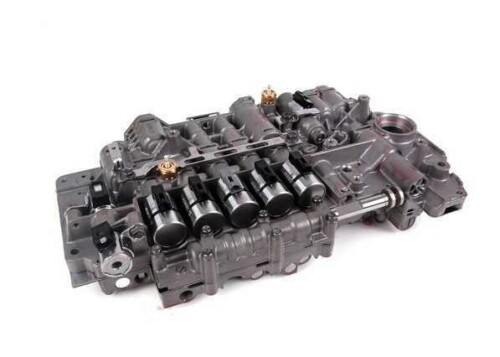
Owners of early 955 and 957 Cayenne models will be familiar with the occasional heavy downshift from the Tiptronic transmission. In some cars this becomes a much harsher gear change, sometimes with a noticeable bang or clunk that sounds as though something substantial has just moved underneath the car.
The fault can be misdiagnosed as a complete transmission failure when the problem actually lies in the valve body or its solenoids. The valve body is the electrohydraulic control assembly that directs pressurized transmission fluid to the appropriate clutch and brake circuits during a gear change. Wear, sticking valves or faulty solenoid control can create some remarkably harsh shifts and unpleasant noises. That said, software, fluid level and mechanical condition still need to be checked before deciding the valve body has failed.
The good news is that, where a valve-body fault has been confirmed, repairing or replacing the assembly can often restore normal, smooth shifts without replacing the complete transmission. However, the correct repair depends on the version fitted, parts availability and the results of the diagnosis. There is little sense in fitting an expensive valve body if a software update or fluid-level correction would have solved the problem.
Hard Downshifts – Tiptronic Software – 958 (92A)
Symptoms: Heavy Downshift, Harsh Kickdown, Bang or Jolt During Gear Change – 2011-on 958 Models with Applicable Tiptronic
A heavy downshift does not always mean that the valve body has failed or that the transmission needs rebuilding. Porsche has a specific repair procedure for some 958 Cayennes that make an unexpectedly harsh gear change, including a kickdown from seventh into fifth or fourth gear. The gearbox can feel thoroughly unhappy even though there is no broken internal component.
Porsche’s symptom-based instruction SY 16/13 identifies the transmission control-unit software as a possible cause. For the applicable vehicle and software version, Porsche directs the workshop to reprogram the Tiptronic controller, and sometimes the engine control unit as well. That is quite a different bill from removing the gearbox!
If the shifts are consistently heavy, record exactly which change causes the problem, whether the transmission is cold or hot and whether the fault happens under light throttle or kickdown. A specialist should check faults, adaptations, fluid condition and the available Porsche software procedure before deciding that a valve body or transmission rebuild is needed.
Automatic Tiptronic Transmission - Concerns
The Cayenne Tiptronic automatic is generally durable, but the exact transmission and repair procedure vary considerably across the generations. Some faults are relatively straightforward to resolve; others require specialist transmission diagnosis and can become expensive. Correct fluid maintenance, at the interval appropriate to the engine and transmission fitted, matters. Cars that cover very little mileage can still have neglected transmission servicing, so check the service history rather than assuming low mileage means the fluid is fine. Use the correct Porsche-specified fluid and level-setting procedure; checking the level at the wrong temperature is a good way to create another problem.
Known issues on the Tiptronic include the following:
Slow or Harsh Shifting
Symptoms: Delayed gear changes, rough shifts, or failure to engage gear.
Causes: Incorrect fluid level or degraded fluid, valve-body or solenoid problems, adaptation faults, or an applicable transmission software issue. Repairs: Identify stored faults and the driving conditions first; check fluid condition and level using the correct procedure, review software and adaptations, then repair the valve body or other component if testing supports it.
Repairs: Fluid and filter change. In some instances valve body rebuild or replacement.
Transmission Overheating
Symptoms: Transmission-temperature warning, restricted operation or unusual shifting, sometimes more noticeable when towing or working the car hard. Causes: Low or incorrect fluid level, a cooling-circuit fault, a restricted heat exchanger, or internal transmission trouble. Repairs: Verify the actual temperature and fault memory, check the fluid level and transmission cooling circuit, then repair the identified cause. A cooler should only be replaced if it has been shown to be defective.
Causes: Clogged transmission cooler or radiator, or low fluid level.
Repairs: Replace the transmission cooler and ensure fluid is at the correct level.
Electrical Control Issues – Fault Codes
Symptoms: No response to gear selector, stuck in gear, dash warning lights.
Causes: Selector or gear-shift control faults, wiring and communication problems, low-voltage events, or transmission-control software; a failed control unit is only one possibility. Repairs: Read the complete fault history with PIWIS and check for a model-specific software procedure before replacing a selector, sensor or control unit.
Repairs: Diagnostic scan to locate faults; replace control module or sensor if necessary.
Torque Converter Problems
Symptoms: A judder or rumble-strip sensation at steady, light throttle when the torque-converter lock-up clutch is being applied; occasionally an abnormal slip reading or related transmission fault. Causes: A lock-up clutch or its control can be responsible, but transfer-case clutch behaviour, engine misfire and tyre-related vibration can feel very similar. Repairs: Reproduce the complaint and compare engine misfire counts, transmission slip/adaptation data and transfer-case operation before condemning the converter. Replace it only if the diagnosis proves it has failed.
Causes: Worn or failing torque converter lock-up clutch.
Repairs: Torque converter replacement.
Transfer Case - Vibrations Under Acceleration or When Turning at Low Speed
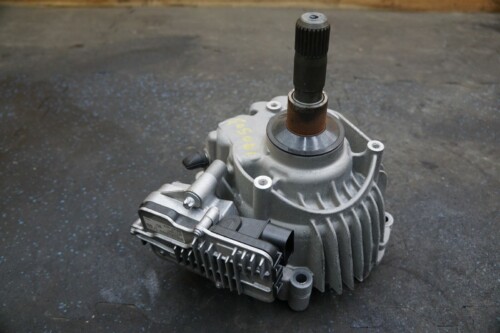 Symptoms: Vibration Under Acceleration or During Low Speed Tight Turns
Many 958 Cayenne owners have experienced a shudder or uneven pull under light acceleration, often in the 25–35 mph range. The problem may start subtly and become more noticeable as the car warms up, especially at low speed or when negotiating a tight turn. It can also feel like a bad gear change as the Tiptronic moves between ratios, even though the transmission itself may be operating perfectly normally.
The transfer case is certainly a well-documented source of these symptoms, especially on the 958, but a shudder on its own is not proof that the transfer case has failed. A misfiring fuel injector, torque-converter lock-up, mismatched tires or another driveline problem can feel surprisingly similar.
Transfer Case Problems
The transfer case sits in the driveline and manages torque distribution between the front and rear axles. On the later active systems, a control unit and an electronically operated multi-plate clutch determine how much drive is sent to the front axle. The different rotational speeds of the left and right wheels are handled by the axle differentials, not by the transfer case. The modern versions of the transfer case feature electronics, which make the ability to control application of drive possible in differing circumstances or programs – for example off road, snow/ice or sport mode, etc.
When the internal clutch pack does not engage and release smoothly, it can produce a stick-slip sensation under load — the classic shudder, hesitation or jerking. Ageing or contaminated fluid and internal wear can play a part. However, a certain amount of driveline tension on full steering lock in an appropriate off-road setting can be normal, so the driving conditions are important.
Porsche has specifically warned that some transfer cases returned under the warranty program tested perfectly well. If the symptoms mainly occur at very low speed with the steering on full lock, especially in an off-road driving mode, distinguish normal driveline tension from a real clutch problem. For later 9Y0 models, also see in our Engine section: Porsche’s fuel-injector test plan SY 41/21 describes a misfire that can feel just like a failed transfer case, even when there is no check engine light. A good diagnosis saves everyone a great deal of money.
If the transfer case has genuinely failed, replacement may be the correct repair. But it should be the conclusion of the diagnosis, not the starting point. Porsche itself introduced specific test procedures and software corrections because too many transfer cases were being replaced unnecessarily. Porsche also issued a transfer-gear warranty extension for 2011–2018 Cayenne models: 10 years from original delivery for 2011–2014 and seven years for 2015–2018, both without mileage limit. These were total coverage periods, not years added to the original warranty, and by today they have generally expired. The dealer can confirm the exact in-service date and any applicable coverage in PCSS.
Clicking From Transfer Case While Parking – AWD Software – 958
Symptoms: Clicking or Creaking From Under the Vehicle at Low Speed, Especially When Stopping or Maneuvering – 2015–16 Cayenne
Some 958 Cayennes develop an irritating click or creak from the transfer-case area when parking, slowing to a stop or driving slowly through a parking garage. It is easy to hear the noise and assume something mechanical inside the transfer case is breaking up. Porsche found that, for a particular group of vehicles, the sound can come from the all-wheel-drive servo motor operating under the direction of older control-unit software.
Porsche TI 84/17 describes a specific test for the problem on certain 2015–2016 model-year vehicles built within the stated production window and running all-wheel-drive software below version 1010. The instructed solution for that exact complaint is control-unit programming. No new transfer case is required simply to cure this software-related click.
The important bit is identifying the sound and confirming the applicable software. This is not the same problem as a transfer gear that jerks under load, and the bulletin expressly says that the clicking-noise procedure does not apply to 2011–2014 models. Two similar noises, two very different possible bills.
Transfer Case Oil Leak – 958 (92A)
Symptoms: Oil Film or Drips Around Transfer Case, Underbody Oil Staining – 2011–2018 Cayenne
The transfer case is best known for the shudder it can produce when the clutch system wears. However, a leak around the transfer gear is a different problem and deserves its own diagnosis. An oily casing can come from more than one seal or joint, and guessing where the oil originated can lead to a repeat leak and another labor bill.
Porsche Technical Information 34/19 describes several different leak locations on the 2011–2018 Cayenne transfer gear, including output-shaft sealing areas and the connection with the automatic transmission. Porsche’s procedure starts by establishing exactly which area is leaking and then performing the repair appropriate to that location. It is not an instruction to replace the entire transfer case whenever the underside looks oily.
An experienced workshop should clean the area, confirm the source after a suitable drive and check the fluid condition before deciding what must be replaced. It is worth catching the problem early, because running a transfer gear with insufficient lubricant is unlikely to end well.
All-Wheel Drive System Error – Software, Not Necessarily Transfer Case – 9Y0
Symptoms: Yellow “All-Wheel Drive System Error”, Sometimes with Driver-Assistance Warnings – 2024–2025 Cayenne
A yellow all-wheel-drive warning on a relatively new Cayenne is naturally alarming. The display may even tell you to drive with caution, and several driver-assistance messages can appear at the same time. It is tempting to assume that the transfer case or its control unit has failed. However, Porsche has identified a software explanation for a specific warning and fault-code combination on the 2024–2025 9Y0 Cayenne.
Porsche ATI 2504 describes code U12B600, “shiftable all-wheel drive control module – no communication”, stored in the Gateway. A software issue can incorrectly interpret that event and trigger the warning. Porsche instructs the workshop to confirm that the all-wheel-drive control-unit software is at release 1301 or later, including the applicable WRX1 software-network campaign, before looking for another fault.
That does not mean every AWD warning is imaginary. If it remains after the correct software is installed, the actual system must still be diagnosed. The useful message is simple: before spending money on expensive all-wheel-drive hardware, check whether the specific software correction has been applied.
Clunking Sound on Acceleration - Drive Shaft Support Bearing Failure
Symptoms: Clunking or Banging Down Center of Car Under Acceleration
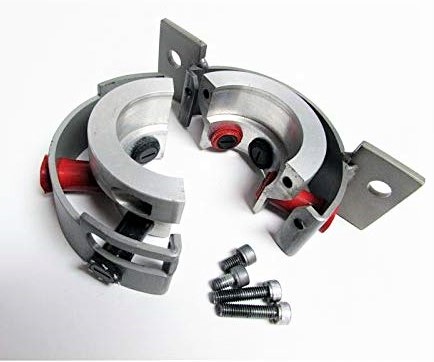
The early 955 and 957 Cayenne are well known for a noisy rear propshaft, often accompanied by a thump or clunk when pulling away, accelerating or changing load. It can sound as though somebody is hitting the underside of the center console with a hammer — which is not a particularly reassuring noise in a Porsche! This is usually caused by a failure in the driveshaft support bearing.
The rear propshaft runs down the transmission tunnel between the transfer-case output and the rear differential. On these early models, its center support includes a bearing held in a rubber mounting. When that rubber support splits or collapses, the shaft can move around far more than it should under load – the shaft wobbles, vibrates and thumps during acceleration.
This is one of the more familiar early-Cayenne repairs, although the mileage at which it appears varies enormously. There are good independent solutions that replace the failed support without the expense of a complete Porsche propshaft. Some kits can be fitted with the shaft still in the car, but that does not mean every shaft is suitable for a support-only repair. If the bearing itself, universal/CV joints or flexible coupling are worn, or the shaft has become unbalanced, a complete quality replacement may make more sense. A good independent Porsche specialist will inspect the entire shaft and choose the repair that actually solves the noise — not simply fit a rubber mount and hope.
Axle Assembly and CV Boot Failure - Clunking Sound Front Axle
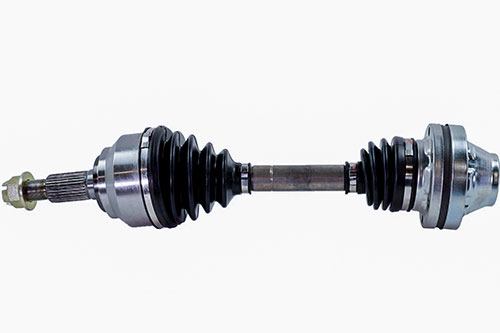 You’re going to find plenty of older Cayennes that have needed work on a front axle or CV boot. Over time, the rubber boot protecting the CV joint can split as it flexes, especially after years of road salt, heat or age-related deterioration. Once the boot opens, grease escapes and road grit gets in. If it goes unnoticed, the CV joint can wear quickly, eventually producing a click on full steering lock, a clunk under load or a vibration on acceleration.
If you catch a split boot before the joint has been contaminated or damaged, cleaning, regreasing and fitting a new boot is often all that is needed. Once a joint is noisy or badly worn, however, a complete axle or properly rebuilt original may be the more reliable repair. Aftermarket axle assemblies vary enormously in quality, so a cheap replacement is not always a bargain. We generally prefer a sound original axle repaired by a competent specialist or a proven OE-quality replacement — provided the condition of the joint actually supports that choice.
Unable to Select Park or Reverse – “Paddle Emergency Operation” – 9Y0
Symptoms: White “Paddle Emergency Operation” Message, Park or Reverse Unavailable – 2024–2025 Cayenne
Imagine pulling into a parking space and finding that the Cayenne refuses to select Park or Reverse. A white “Paddle emergency operation” message appears, and the natural conclusion is that something expensive has failed inside the Tiptronic. On certain 2024–2025 models, Porsche has identified a software problem in the gear-shift mounting controller instead.
Porsche Technical Information 62/25 identifies U010300 in the transmission electronics and B19DFF0 in the instrument cluster. A communication interruption between the gear-selector controller and Tiptronic can place the system into a temporary emergency mode. Switching the ignition off and back on may make the symptom disappear for a while, but it can return.
Porsche specifies reprogramming the gear-shift mounting control unit for this defined fault pattern. Do not jump from a selector warning to condemning the transmission or buying a new gear lever. On the other hand, a vehicle that cannot be safely secured in Park is not something to shrug off. Follow the dashboard instructions and arrange proper diagnosis before returning it to use.
Oil Leak Between Automatic Transmission and Transfer Case – 9Y0
Symptoms: Oil on Transmission Pan, Transfer Gear or Between Units – 2018-on 9YA/9YB Cayenne
Oil visible where the automatic transmission and transfer case meet is not necessarily coming from the component that looks the wettest. On the later Cayenne, airflow beneath the car can move oil along the housings, making the transfer case look guilty when the leak actually began at the transmission, or vice versa.
Porsche has issued two complementary procedures — SY 205/20 for automatic-transmission leaks and SY 206/20 for transfer-gear leaks. Both explain how an incorrect initial diagnosis can lead to unnecessary or ineffective repairs. Possible sources include shaft seals at the joint between the units and other nearby sealing points. The sensible procedure is to photograph and clean the area, reproduce the leak and identify the source before ordering components.
That may sound like basic workshop practice, but the alternative is to replace an expensive seal, put the car back together and discover that the oil was coming from somewhere else. A proper leak diagnosis is much cheaper than doing the same repair twice.
Rear Drive Shaft Rubbing Air Suspension Bellows – 2024 Cayenne
Symptoms: Abrasion Marks on Rear Drive Shaft, Possible Contact With Rear Air Spring
Not every mark on a drive shaft comes from a failed CV joint or an object thrown up from the road. Porsche identified a specific interference condition on some 2024 Cayennes fitted with the relevant adaptive air suspension. Under certain high-load and suspension-compression conditions, the rear air bellows can make contact with the rear drive shaft.
Porsche Technical Information 124/23 explains that an incorrect air-bellows wall thickness can allow the components to touch, leaving abrasion or worn paint on the shaft. Porsche directs the workshop to replace the affected air bellows with the revised part and inspect the drive shaft, replacing it if the inspection shows damage. The repair is not simply a case of fitting another axle or a new CV boot.
This is a vehicle and equipment-specific concern rather than a failure of every Cayenne rear axle. However, if unusual rubbing marks are found during a suspension inspection, the shop should check the Porsche bulletin before dismissing them as ordinary wear.
Electrical System Faults and Driver Assist
Porsche Communication Management (PCM) Issues
Symptoms: PCM restarting every 2–3 minutes, navigation map not loading, incorrect language, Porsche logo permanently displayed, screen going blank, or the unit randomly switching on and off.
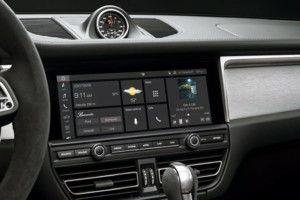 Who hasn’t had an issue with the PCM system in their Cayenne?
Many Cayenne owners have reported all sorts of random and weird behavior from the PCM system, and software problems or updates often seem to be involved. Many owners are convinced that a software update caused their trouble, although the timing alone doesn’t prove it. On later models, Porsche has actually documented specific software faults that can make a PCM freeze, restart or refuse to operate normally. A perfectly functioning PCM can suddenly exhibit the strangest behavior described in the symptoms above. Many are convinced that various software updates resulted in unstable working conditions. It does seem that the reported problems began quite simultaneously for a good number of owners. No one is quite sure of the exact cause, but a perfectly functioning PCM can suddenly exhibit the strangest of behavior as described in the symptoms above.
Defining the Issue with the Cayenne PCM
The problems with the PCM can really be categorized in to two groups.
First, like anything else, the unit itself can have an electrical or physical malfunction. That may cause a complete loss of functionality rather than the loss of a single feature or the occasional strange behavior. However, a completely black screen does not automatically mean the hardware has failed. Porsche has published specific software repair procedures for certain Cayenne PCM faults, and those should be checked before condemning the unit. If the PCM really has failed internally, replacement can be expensive, although specialist electronics repairers may offer an alternative for some older units. Porsche dealers generally work to Porsche’s prescribed replacement or programming procedure.
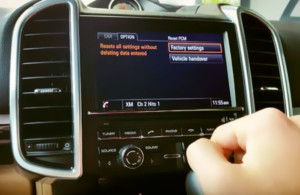 For the second set of Cayenne PCM problems that generally fall into the strange behavior category, an old-fashioned Ctrl Alt Del may get things working again. Some will remember when it was necessary to do this a couple of times a day on a Windows PC! Restarting a frozen PCM is worth trying, but if it continually reboots, loses functions or goes black, you need to check the software version and fault history rather than repeatedly resetting it. Porsche has documented a memory-allocation problem on certain 2019–2021 Cayennes running Cluster 26 PCM software, and separate PCM fault patterns on some 2022–2023 cars. Those problems have specific Porsche workshop procedures. Some will remember when it was necessary to do this a couple of times a day to a Windows PC, but in this instance, the PCM usually recovers well to an initial start point and then functions normally.
Resetting The PCM System in Your Cayenne
It’s important to understand the difference between restarting the PCM and restoring its factory settings. A restart is intended to recover an unresponsive system; a factory reset is a more substantial step and, depending on the PCM generation and menu option selected, may remove saved personal settings or user data. Back up anything important before selecting a reset. The video below demonstrates the procedure for the PCM generation shown, but the menu options and method are not necessarily the same on every Cayenne. We would try the correct reset procedure before paying for a replacement unit, but we wouldn’t treat it as a cure for a recurring software or hardware defect.
The following video explains how to perform a reset of the PCM:
No Start - Steering Faulty - KESSY
Symptoms – Steering Faulty Message On Dash – Car Will Not Respond to Key
 This problem happens when a convenience system becomes inconvenient!
Porsche added the KESSY keyless entry and starting system to the Cayenne as a convenience for the driver, or a second driver with a different key. Unfortunately, the early system can become less than convenient as the car gets older. The steering-lock problem described below is particularly relevant to the first-generation Cayenne, the 955 and 957 (2003–2010). It should not be assumed to be the cause of every no-start complaint on a later 958 or 9Y0. Unfortunately, the initial system is less than reliable and has a reasonable high failure rate in older Cayenne models.
Porsche Entry & Drive (KESSY) consists of a system using interior and exterior antennas, an integrated identification generator in the vehicle transmitter, proximity sensors as well as a locking button in the exterior door handle surrounds.
The driver carries an ID sender integrated into the vehicle key. When the system recognizes the key, it can unlock the doors and, where the relevant memory equipment is fitted, recall the seat and climate control settings for that driver. Very clever when it works!
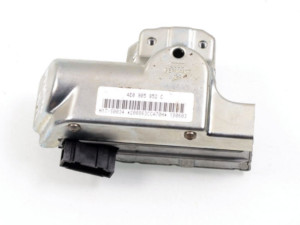 Steering Lock Problems and Resolutions
Kessy also encompasses the security system for the alarm and steering lock systems.
There are several parts to this system, including the keys, antennas, KESSY control module and electronic steering lock. Loss of keyless entry does not necessarily mean the steering lock has failed. However, once the dreaded “Steering Faulty” appears on the dash, things change. The steering wheel may remain locked and the car can become unresponsive to the key. On the early Cayenne, a failure of the electronic steering lock integrated into the steering column is one possible cause. It can leave the car literally stuck where it is until you have it recovered. A flat battery, an unrecognized key or a fault elsewhere in the immobilizer system can produce similar symptoms, so the diagnosis needs to come before the expensive parts order.
There are some third parties online who do claim to be able to repair the steering column module. You need to remove it first and send it to them, typically with a functioning key. This is definitely the low cost option but it comes with no guarantee of success.
Random Airbag Fault - Airbag Light
Symptoms: Airbag Warning Light Illuminated, May Appear Intermittently or Remain On
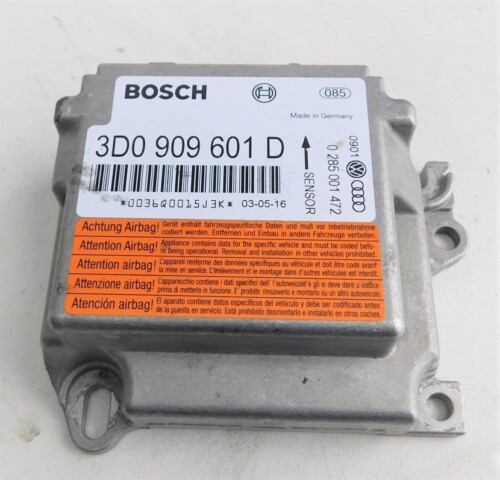
Many early model Cayenne drivers have noted that their airbag fault light flashes randomly. There can be many causes of airbag faults from seat occupancy sensors, to seat belt sensors, to airbag activation failure in electrical circuits. As with any safety system, it’s important to accurately diagnose the problem and we recommend a Porsche specialist.
There is, however, a documented problem with the electrical connections to the FRONT SEAT SIDE AIRBAGS on some early cars. On 2003–2004 Cayennes, Porsche issued a technical bulletin for intermittent contact problems in the front-seat side-airbag plug connections, often accompanied by fault code 1217 or 1218 in the airbag control unit. The main airbag control unit is not simply an under-driver-seat module; the relevant early Cayenne control unit is housed beneath the centre console. An incorrect contact resistance in the airbag circuit is enough to trigger the warning, even when the airbag itself is not defective.
Front Seat Side Airbag Connector Issues
Porsche’s technical bulletin identifies poor contact in the wiring connection to the side airbag on the driver and passenger seats. For the specified 2003–2004 cars and fault codes, Porsche’s workshop repair replaces the affected plug connections with the prescribed crimped wiring connections on BOTH front seats. That work involves the airbag system and is not a sensible DIY experiment. Water damage and corrosion can certainly cause electrical faults elsewhere in a Cayenne, but they should be established by inspection rather than assumed to be the reason for an airbag warning. There is no justification for replacing the main airbag control unit simply because the warning lamp has come on.
Water Leaks - Blocked Drains and Electrical System Damage
 Symptoms: Electrical System Failures – Strange Electronic Behavior – Water in The Cabin or Trunk
Part of the annual maintenance schedule for Porsche vehicles is the clearing of roof drains. However, this has been overlooked and not carried out in many circumstances. The resultant damage from blocked roof drains can be extensive.
Porsche Sunroof Drains
If your Cayenne has a sunroof or panoramic roof, there are drainage channels and tubes designed to carry water away from the roof opening to outlets lower down the bodywork. The familiar four-drain arrangement is common, although the exact layout and access points depend on the roof and generation. These drains can become blocked with leaves, dust and general road dirt. They can also become disconnected, split or leak at a joint. Once water cannot escape properly, it finds another route – and unfortunately that route can take it surprisingly close to expensive electronic equipment.
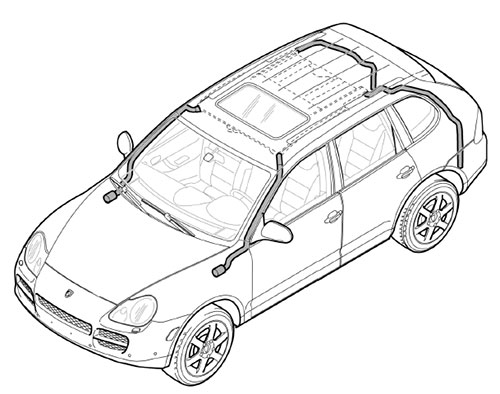 Finding Water Leaks in Your Cayenne
If you discover water in the trunk or passenger cabin, blocked or failed roof drains are an important place to look on a sunroof-equipped Cayenne – but they are not the only possibility. Windshield or body seals, door moisture barriers, HVAC or cowl drains and rear hatch seals also deserve attention, depending on where the water appears. The water can travel away from its original entry point and get into wiring harnesses, electrical connectors and control modules. Those repairs can be expensive, especially where security programming is involved. Before agreeing to a replacement control unit, make sure the source of the leak has been found, the relevant wiring inspected and the area dried properly. Otherwise, the replacement part may end up swimming in exactly the same water as the original!
Prevention of the Water Leak Problem
Clearly, preventing a blocked drain is better than replacing an expensive electrical control unit. We recommend inspecting and clearing the roof drains during routine maintenance, particularly if the Cayenne lives outside, is parked beneath trees or has already suffered a water leak. The drain tubes and their connections should also be inspected where there is evidence of leakage. Aggressively forcing wire or compressed air through a tube can disconnect or damage it, so this is a job worth doing carefully. Where you service your Porsche can make a world of difference! We recommend using a Porsche specialist.
In the United States, a settlement was reached in the Washburn v. Porsche Cars North America sunroof-drain case involving certain 2015–2023 Cayennes equipped with a sunroof. The deadline for submitting reimbursement claims was February 4, 2025, so that part of the settlement is now closed. However, eligible vehicles may still qualify for other settlement benefits, including annual sunroof-drain cleaning within the applicable age and mileage limits. Check the official settlement information and your vehicle’s eligibility before paying for work you may be entitled to receive.
No Start After Parking – 12V Battery or Battery Sensor – 9Y0
Symptoms: Vehicle Completely Dead After Parking, Will Not Unlock or Start, Low 12V Battery Warning, Battery Replacement Recommended.
If your later Cayenne has been parked for a few days and suddenly refuses to unlock or start, it’s tempting to order a new battery and get on with life. Unfortunately, the 9Y0 has a more complicated electrical system than the older cars, and on some versions a battery that appears to be completely dead isn’t necessarily defective.
Porsche has published a technical procedure for diagnosing its 12-volt lithium-ion battery. The battery has protection functions that can temporarily disconnect it to prevent damage, and that condition can be mistaken for an outright battery failure. There is a Porsche-approved method for checking what happened and restoring the battery where appropriate. Replacing a perfectly serviceable lithium battery is a remarkably expensive way of avoiding the proper diagnosis!
Porsche has also issued battery-sensor software campaigns. WSA4 applies to certain 2019–2024 Cayennes fitted with a specific LG-Chem battery and can cause an incorrect recommendation to replace the 12V battery. WSS6 applies to selected 2019–2026 Cayennes and addresses incorrect battery data that may leave the vehicle unable to start after being parked for a longer period. These are VIN-assigned workshop campaigns – the date range does NOT mean every Cayenne is affected.
Have a Porsche specialist check the installed battery type, its protection status, actual condition, battery-sensor data and any outstanding campaigns before fitting an expensive replacement. Use the correct Porsche battery support and diagnostic procedure; a generic charger or improvised jump-start is not the solution for every lithium-battery fault.
Battery Going Flat Overnight – Connected Services and Head-Up Display – 9Y0
Symptoms: Battery Flat After a Day or Two, Vehicle Will Not Unlock, No Start After Sitting, Repeated Low-Voltage Warnings.
A Cayenne that starts perfectly after a drive but regularly has a flat battery after sitting may not have a bad battery at all. Something can be staying awake when the vehicle is supposed to be asleep. These faults are frustrating because the car can test perfectly well in the workshop and still be dead the following morning.
Porsche has documented excessive standby current draw from the Connected Services control unit, known as the ConBox, on certain 2019–2021 Cayennes. The bulletin specifically concerns the earlier ConBox Low unit; Porsche changed that equipment during 2021. In some cases an alarm or connected-services setting complicates the diagnosis. This is one of those faults where pulling fuses at random is a particularly bad idea. Disconnecting the ConBox without putting the vehicle in the proper service mode can trigger a vehicle-tracking-system alarm.
There is also a separate Porsche bulletin for 2019–2021 Cayennes fitted with the optional head-up display. A head-up display control unit that fails to go to sleep can discharge the battery, and the unit may not even store a useful fault code of its own. Porsche’s procedure uses the vehicle’s diagnostic data to identify that condition before programming the affected unit.
The correct starting point is a proper battery and charging-system test followed by a measured parasitic-current investigation once the vehicle has entered sleep mode. Then identify which module is responsible. Replacing the battery without finding the drain will simply buy you another flat battery – possibly quite soon.
Red Vehicle Electrical System Malfunctioning – 9Y0
Symptoms: Red “Vehicle Electrical System Malfunctioning – Stop Vehicle Safely” Warning, Multiple Dash Warnings, Possible Engine Shutoff.
There’s a big difference between a yellow electrical warning that needs investigating and the red “Vehicle electrical system malfunctioning – stop vehicle safely” message. If your Cayenne produces the red warning, take it seriously. Find a safe place to stop and do not continue driving in the hope that the message will disappear.
On the later 9Y0 Cayenne, Porsche has identified a surprisingly physical cause for one version of this problem. The terminal 15 signal wiring can chafe where the harness passes close to the air-conditioning compressor and the engine oil pan. Eventually the wiring insulation can wear through and create a short circuit. Porsche notes that the vehicle may deliberately shut down the engine as a safety response to that electrical fault.
The documented fault pattern includes code B114811 in the rear-end electronics control unit. That code and the location of the damaged harness are important; we wouldn’t assume every red electrical warning is the same defect. A Porsche specialist should check the stored faults, inspect the harness where Porsche specifies and repair and protect any damaged wiring using the proper workshop procedure.
This one is a good reminder that an apparently complicated electronic failure can be caused by an ordinary piece of wiring rubbing on something it should never have touched. The expensive part is often finding it rather than fixing it. However, if the red warning appears, arrange recovery rather than driving on.
Front Window Reverses or Won’t Close – 9Y0
Symptoms: Window Rises Then Drops Back Down, One-Touch Closing Stops Working, Window Cannot Open or Close Correctly.
If the front window on your Cayenne starts going up and then reverses as though something is trapped in the glass, you’re not necessarily dealing with a faulty switch or door control module. It can be a window that has lost its basic settings, or one that is meeting more resistance than the anti-trap system expects.
Porsche has a specific troubleshooting procedure for this fault on later Cayennes. The first step is to check and re-normalize the window operation. If that doesn’t solve the problem, the cause can be a damaged window seal, dirt on the glass, resistance in the regulator mechanism or, in some cases, a failing window motor. Porsche also lists fault codes B148754, B148729 and B14874B as possible diagnostic clues.
The temptation is to replace the window regulator or motor, particularly if the fault appears intermittently. However, we’d want to know whether the glass is binding in the guides, whether the seals are damaged and whether the window was correctly initialized before authorizing new parts. Porsche specifically advises diagnosing the problem before replacing components.
If the window cannot close, protect the interior from rain until the fault is repaired. Water inside the door or cabin has the potential to turn a relatively straightforward window problem into one of the electrical faults discussed above. No point fixing one problem by creating a much more expensive one!
Reversing Camera or Surround View Screen Blank – 9Y0
Symptoms: No Camera Image When Reverse Selected, Black Reversing Camera Display, Surround View Image Missing.
The reversing camera is one of those features you quickly get used to on a vehicle the size of the Cayenne. When it stops displaying an image, the first thought is often that the camera itself has failed. That may be true, but Porsche has also documented software and assistance-system faults that can produce a blank display.
Importantly, Porsche announced a US safety recall, ASB2, covering certain 2019–2025 Cayennes and Cayenne E-Hybrids because the rear-view camera image may not appear when the driver selects reverse. This is not merely an annoying PCM problem – a missing image reduces visibility behind the vehicle. The recall remedy is an update to the driver assistance software on the affected cars.
As always, the VIN matters. Not every Cayenne built in those years is covered, and a damaged camera, wiring fault or failed surround-view component can produce similar symptoms on a car that is not part of the recall. Check the VIN against Porsche’s recall information before paying to have a camera replaced. If no recall applies, the diagnosis should include the camera, its wiring, relevant control modules and software status.
Until the problem is resolved, don’t assume the view behind the car is clear just because the parking sensors are quiet. Use the mirrors and physically check behind the vehicle before reversing. A camera is useful, but it was never a substitute for looking where you’re going!
False Lane Change Assist or Rear Cross Traffic Warnings – 9Y0
Symptoms: Lane Change Assist Flashes With No Vehicle Nearby, False Rear Cross Traffic Warning, Intermittent Assistance Warnings.
The Cayenne’s driver-assistance systems are clever, but they do rely on the sensors being able to see what is actually around the car. If the lane-change warning suddenly starts flashing when there is nothing beside you, don’t immediately assume the radar sensor has failed.
Porsche has published a technical bulletin explaining how excessive paint thickness, incorrect bumper repairs, stickers or protective film over the corner radar areas can interfere with these systems. On a later Cayenne fitted with Lane Change Assist, this can cause false alerts from the rear cross-traffic or lane-change warning system. It is worth asking whether the bumper has been repainted, repaired or covered in film – particularly if the problem began shortly after bodywork.
The radar sensors sit behind the bumper covers, which means the part you can see may appear perfectly normal. Porsche’s workshop procedure includes checking relevant software, the sensor area, wiring routing and the thickness of paint on the plastic bumper. An ordinary paint-thickness gauge intended for metal panels may not be suitable for that job.
This doesn’t mean every warning is caused by a resprayed bumper. Sensor faults, collision damage, wiring problems and calibration issues still need proper diagnosis. What we wouldn’t do is approve the cost of new radar modules until the workshop has checked whether the bumper finish is actually preventing the old ones from working.
Lane Change Assist Unavailable – Defective Control-Unit Revision – 958
Symptoms: “Lane change assist not available, service required”, intermittent blind-spot assistance failure, fault codes C111504 or B200000 – 2016–2018 Cayenne models.
An intermittent Lane Change Assist failure on a 2016–2018 Cayenne model with the system fitted does not necessarily mean that the radar sensor is dirty or the bumper has been damaged. Porsche documented a particular fault involving early revisions of the lane-change assistance control modules.
Porsche bulletin 1601.1 identifies fault codes C111504 and B200000. The critical detail is the hardware and software level of the affected control units. Porsche says a master control unit operating at software level 160 requires replacement. Hardware revision H06 is also identified as defective; Porsche specifies replacing affected H06 units in matched left-and-right pairs, while H05 and H07 are not affected by that particular condition.
There is no sense replacing both modules simply because the warning appears. The workshop needs to read the codes, check the actual part and revision levels and follow the relevant Porsche instructions. If the system is unavailable, continue using your mirrors and shoulder checks rather than relying on the warning light to identify traffic beside you.
Multiple Assistance Systems Unavailable – Front Camera/Video Fault – 9Y0
Symptoms: Lane Keep Assist unavailable, speed-limit display missing, Warn and Brake Assist restricted, several white warnings disappear after restarting, code C12D5FA – 2019-onward Cayenne models.
It is quite possible for a later Cayenne to display several assistance-system warnings at once, then behave perfectly normally after switching the ignition off and back on. Naturally, this makes the problem difficult to demonstrate at the workshop. It also encourages the expensive habit of replacing whichever camera or control module looks most suspicious.
Porsche Technical Information 75/25, revised in February 2026, covers a specific fault identified by C12D5FA in the driver-assistance control unit (ZFAS) on certain 2019-onward Cayenne models. Porsche makes a crucial distinction. If C12D5FA is stored as a passive fault, the documented repair involves installing a revised video line between the front camera and assistance controller to address possible electromagnetic interference. If that specific code is active, Porsche instead identifies a possible internal control-unit problem and instructs replacement of the ZFAS controller.
Those two repairs are very different, so the active or passive status matters every bit as much as the code itself. Other warning codes, dirty camera glass and actual radar faults require their own diagnosis. Have the specialist confirm the exact fault combination and current Porsche instructions before replacing an expensive camera or radar unit.
Tire Pressure Monitoring Fault – Wheel Positions Not Learned – 9Y0
Symptoms: “Fault monitoring tire pressure – Service necessary,” positions not recognized, warning after changing tires or wheels – selected 2020–2022 9Y0 Cayenne models
On the later Cayenne, the tire-pressure monitoring system does rather more than display a pressure number for each corner. It also works out which electronic transmitter belongs to which wheel. When that identification process fails, the driver can get a warning even though the pressures have been checked and there is no puncture.
Porsche workshop campaign WMK8 covers a specific calibration defect in wheel electronics fitted to selected 2020–2022 Cayenne models. The wheel sensors may not identify their direction of rotation correctly, preventing assignment to their respective wheel positions. Porsche identifies fault C102DF3 for this condition, particularly after wheel changes or manual selection of a wheel set. Earlier technical guidance, 226/20, also describes a teaching issue on certain 2020–2021 vehicles.
A specialist should first verify the tire pressures, installed wheel equipment, learning procedure and stored faults. On an assigned WMK8 vehicle with the affected wheel set, Porsche specifies replacing only the sensors identified in the campaign scope and then completing the necessary programming. This is not an invitation to replace all four transmitters on every Cayenne with a TPMS warning; older 955, 957 and 958 systems have their own components and failure patterns.
Surround View Partly or Completely Black – 9Y0
Symptoms: Real Top View missing, one side camera black, intermittent surround image failure, view returns after restart – 2019-onward Cayenne models equipped with Surround View
When one of the Cayenne camera views disappears, the natural conclusion is that the failed image identifies the failed camera. That seems logical, until you discover that Porsche has published a fault procedure covering the camera communication system rather than necessarily the camera itself.
Porsche Technical Information 03/26 describes sporadic partial or complete loss of Real Top View on 9YA/9YB Cayenne models with Surround View. An outdated assistance-systems control-unit software version can be responsible. On vehicles already running the correct software, unfavorable electrical contact in the mirror-camera signal-line connectors can produce the same complaint. Porsche therefore tells the workshop to check the installed software and either update the assistance controller or rework the specified signal-line connections.
That is very different from a parking sensor failing to beep, and it should not be confused with a VIN-specific rearview-camera recall. Have the workshop record which camera view is missing, examine the stored codes, inspect the relevant connectors and check Porsche’s latest procedure before replacing an expensive camera or controller. A black image on its own is not a diagnosis.
Before authorizing a harness repair, there is another useful Porsche document to check. Technical Information 43/26 extends warranty coverage for the specific front-door wiring-harness crimp defect that can interrupt Real Top View camera images. Only selected VIN-assigned 2019–2025 9YA/9YB Cayenne models in the USA, Puerto Rico and Canada qualify. Coverage generally continues through December 31, 2027 with unlimited mileage; some individual vehicles may have coverage into 2028. It transfers with the vehicle. Porsche says it does not generally plan to notify owners proactively, so ask a Porsche Center to check the VIN and expiry in PCSS before paying for a replacement harness. A failed camera, software issue or other damaged wiring does not automatically qualify for the extension.
Front Seat Knocks or Whines During Adjustment – 9Y0
Symptoms: Loud Whining, Clicking or Knocking from Front Seat Frame When Moving Seat Forward or Back – 2018–2024 Cayenne models with electric front-seat adjustment
An electric front seat making a nasty clunk while moving forward or backward sounds expensive. The immediate assumption is usually that the seat motor has failed or the complete frame is worn out. Porsche has identified a rather less dramatic possibility on certain later Cayenne models.
Porsche bulletin SY 95/23 covers knocking or whining while operating the fore-and-aft seat adjustment. The adjustment motor may have come out of its mounting, or the seat frame may have been installed under excessive tension. The factory procedure starts by checking that the motor is correctly seated, then checking and relieving mounting tension where required. Only if the noise remains after those checks does Porsche direct replacement of the affected seat frame.
This issue concerns equipped 2018–2024 9YA/9YB vehicles and should not be used to explain every seat noise. A damaged track, dropped object or genuinely failed motor can sound similar. Have the specialist reproduce the noise while operating the seat and inspect the mounting before ordering an expensive frame. Do not continue forcing a seat that is clearly jamming, particularly if it affects a safe driving position.
HVAC System
Noisy or No Function from HVAC Fan
Symptoms: HVAC Fan Stops Working, Runs at One Speed, Works Intermittently or Makes Excessive Noise
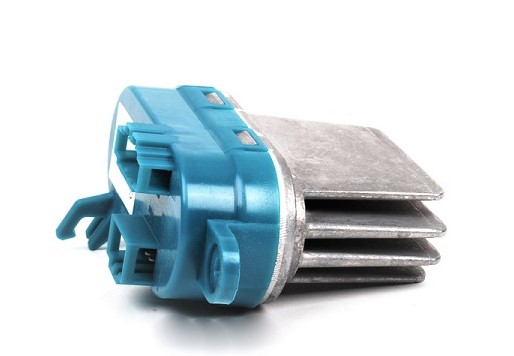
A common problem in the Porsche Cayenne is a condition where the climate control fan suddenly starts working intermittently, or only at one speed, or not at all. It may also become excessively noisy.
Blower Motor Regulator
The variation in the speed of the HVAC blower fan is controlled by the blower motor regulator or electronic fan controller, depending on the model. Once the regulator fails, the fan may run at one constant speed, work intermittently or stop altogether despite attempts to change the speed through the controls. Replacing the regulator is typically less expensive than replacing the complete blower assembly, but it is only the solution when the regulator has actually failed.
Blower Motor Failure
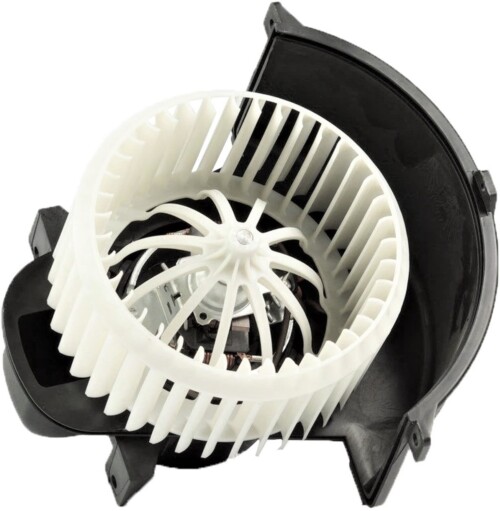 When the HVAC blower fan has no speed at all or becomes excessively noisy, the blower motor itself may have failed. A worn motor bearing, damaged fan wheel or debris trapped in the housing can make quite a racket, but a failed regulator, wiring connection or power supply can also stop a perfectly good motor. The blower is reached through the passenger-side lower dashboard or footwell area on many Cayenne models; the exact access and labor involved vary by generation.
It does not automatically make sense to replace the fan and regulator together. An ageing or partially seized motor can put additional strain on its controller, so check the condition and current draw of the motor before deciding whether one or both components need replacing.
Air Conditioning Blows Warm Air - Refrigerant Loss or A/C Leak
Symptoms: Air Conditioning Blows Warm Air, Cooling Gets Progressively Weaker, A/C Stops Cooling Again After Being Recharged
If the Cayenne air conditioning stops blowing cold air, the first thing to establish is whether the system has the correct amount of refrigerant. Refrigerant does not get used up like fuel. If the system needs topping up repeatedly, it has a leak somewhere. Simply recharging it and hoping for the best is unlikely to be much of a long-term solution.
Leaks can develop at hose connections, seals, the condenser, compressor connections or the evaporator inside the dashboard. The important part is to find the leak before replacing expensive components. A pressure or electronic leak test, carried out using the correct procedure and refrigerant equipment for the car, is considerably more useful than guessing at a compressor.
On the later 9Y0 Cayenne there is a particularly useful Porsche bulletin. Technical Information 174/23 describes poor cooling caused by damaged or twisted O-rings where the refrigerant lines connect to the air-conditioning compressor. Refrigerant oil may be visible around the line flange or collecting at the lowest point of the compressor. Porsche calls for inspection of the seals and replacement where required – not an automatic compressor replacement. The bulletin applies to the specified non-hybrid 9YA / 9YB vehicles, so check the model and the latest Porsche workshop instructions.
A leaking evaporator is also possible, but it is a substantial repair because of its location inside the HVAC housing. We would want to see convincing leak-test evidence before approving dashboard removal. A Porsche specialist should be able to establish whether the system is genuinely low on refrigerant, is being inhibited by an electrical fault or has a separate airflow problem.
Airflow from the Wrong Vents - Heater and A/C Flap Actuator Faults
Symptoms: Clicking or Whirring Behind Dashboard, No Air at Selected Vents, One Side Hot and the Other Cold, Defroster or Footwell Airflow Incorrect
The Cayenne climate control system uses a collection of small electric motors to position flaps inside the heater and air-conditioning housing. These flaps decide where the air goes and, on multi-zone systems, how much hot or cold air each area receives. When an actuator or its position feedback fails, the airflow may be stuck on the windshield, refuse to reach the footwells or deliver the wrong temperature on one side of the cabin.
Early 955 and 957 Cayennes have a number of individual flap motors, and ageing motors and drive mechanisms are a familiar source of clicking and incorrect air distribution. Before anyone proposes removing the entire dashboard, have the workshop use Porsche-compatible diagnostics to command the affected flap motors and check their movement and fault history. In some cases individual actuators can be reached from below the dash; other locations are considerably more involved.
Not every air-direction problem is a broken flap. Porsche Technical Information 74/18 documents an air-conditioning control-unit software issue on 2018-2019 9YA Cayennes, where particular vents supply the wrong temperature, unwanted air or no air. For the specified vehicles with control-unit software below version 1040, Porsche directs a software update. A good diagnosis establishes whether the problem is a motor, a stuck flap, a sensor or simply the software telling everything to do the wrong thing.
Air Starts Cold then Warms Up - Interior Temperature Sensor Error - 958
Symptoms: A/C Starts Cold but Blows Warmer Air Before Cabin Has Cooled, Fan Speed Drops Unexpectedly, Ventilated Seats May Not Operate
There is a rather clever little fault on some early 958 Cayennes that makes the air conditioning appear to have a mind of its own. The system starts cooling normally, but after a short while the air becomes warmer and the blower slows down – even though the cabin is still far too hot. Naturally, it is tempting to suspect a refrigerant problem or a failing compressor.
Porsche Advanced Technical Information 1102 identifies a different cause. Cold air escaping through the clip openings on the side of a dashboard vent reaches the rear of the interior temperature sensor. The sensor thinks the cabin is much cooler than it really is and the climate control reduces cooling and fan speed. The fault can also prevent the ventilated seats from switching on.
The Porsche repair involves correctly sealing the relevant openings in the vent housing with felt tape while retaining proper clip operation. A remarkably inexpensive fix compared with a compressor or complete climate-control unit! It is worth checking this exact symptom and vehicle configuration before starting an expensive air-conditioning investigation.
Little or No Heat from Cabin Vents - Heater Coolant Flow - 9YA
Symptoms: Cold or Lukewarm Air with Temperature Set to Hot, Weak Heat at Idle, Heat Missing from One or More Cabin Zones
If your Cayenne has a hot engine but produces little heat inside the cabin, the problem is not necessarily in the dashboard. The heater requires a supply of hot coolant, and a stuck coolant-flow valve, air trapped in the cooling circuit, poor circulation through the heater core or a failing auxiliary circulation pump can all produce inadequate heat. A temperature-mixing flap stuck on cold can create the same symptom even when the heater core is hot.
The first step is to confirm the actual engine and coolant temperatures, coolant level and whether hot coolant is reaching and leaving the heater core. These checks help separate a heating-circuit problem from a flap-motor or control issue. Replacing the heater core without establishing coolant flow can turn an otherwise straightforward fault into an enormous bill.
Porsche has also documented a specific assembly fault on certain 2019-2020 Cayenne Turbo models. Advanced Technical Information 2216 describes incorrectly connected coolant lines on vehicles assembled before 10 January 2020, restricting flow through the heater core. This needs the exact model and production period to match; it is not a general explanation for every Cayenne with poor heating. If the cooling system has been worked on recently, checking how the hoses were routed is especially sensible.
Wet Carpets or Musty Smell - Air Conditioning Condensate Drain - 958
Symptoms: Water in Front Footwell, Damp Carpet After A/C Use, Musty Smell, Condensation Entering Cabin
Water inside the Cayenne is often blamed on blocked sunroof drains, and rightly so. However, there is another source that is easily missed – the air-conditioning evaporator drain. The A/C naturally produces condensation when cooling the air. That water should drain outside the car. If it backs up inside the heater housing, it can soak the carpet and eventually threaten electrical connectors and equipment beneath the dashboard.
Porsche Advanced Technical Information 1801 identifies an evaporator drain problem on some 2014-2017 Cayennes (92A). The supplier had not completely cut the drain flap, restricting the opening and allowing condensation to back up into the vehicle. Porsche describes correcting the flap opening or replacing the affected drain, then cleaning and reinstalling the drain.
There is also a separate Porsche workshop campaign, WNP5 (Technical Information 67/23), for selected 2017-2018 Cayennes. Here the concern is a drain hose on the heating/fresh-air unit that was not manufactured to specification. The specified repair is replacement of the hose. This is a VIN-assigned campaign, not a recall covering every Cayenne. Have the shop check Porsche PCSS for the individual car before charging for that work.
If the carpets are wet, find the source and dry the affected areas properly. Clearing a sunroof drain will not solve a faulty A/C drain hose, and neither will a new A/C drain solve a leaking roof or door seal. We would want to know where the water is actually entering before declaring the job complete.
A/C Blows Warm or Cabin Fan Keeps Running - Air Ionizer Fault - 2019-2023 9YA / 9YB
Symptoms: A/C Suddenly Blows Warm Air, Cabin Blower Remains Active After Climate System Is Switched Off, Fault U107600
Some later Cayennes develop a very odd air-conditioning fault. The A/C blows warm when it should be cooling, or the cabin fan continues to run after the climate control has been switched off. It is easy to imagine an expensive failure in the HVAC control unit. However, Porsche has identified an apparently unrelated component that can cause both problems.
Porsche Advanced Technical Information 2522 covers 2019-2023 9YA / 9YB Cayennes equipped with the optional cabin air ionizer (option 2V4). A fault inside the ionizer can interfere with the LIN bus used by the climate-control electronics. The workshop should find U107600 – LIN bus 2 electrical fault – in the air-conditioning control unit. Porsche directs replacement of the affected ionizer with the specified improved part before continuing with other A/C diagnosis.
If the equipment and fault code match, this is a much more useful place to start than replacing the compressor or climate-control panel. Note that the bulletin concerns the cabin climate-control fan, not the engine cooling fans that may run after shutdown under normal circumstances. Do not confuse the two.
A/C Temporarily Heats or Stops Blowing - 9Y0 Climate Software
Symptoms: A/C Briefly Blows Hot Instead of Cold, Little or No Airflow for Several Minutes, Then Works Normally, No Fault Codes
An intermittent air-conditioning problem is particularly irritating when everything works perfectly again by the time the car reaches the repair shop. On certain 2024-2026 Cayennes, owners may experience a few minutes of unexpected heating or almost no airflow before the system returns to normal without any intervention.
Porsche Technical Information 06/26 describes a software-related condition associated with the climate control function that detects driving through tunnels and automatically adjusts air recirculation. Porsche specifically notes that there may be no fault entries stored in memory. For the vehicle and complaint covered by the bulletin, the remedy is to reprogram the air-conditioning control unit using the Porsche tester.
That makes a useful first check before replacing blend-flap motors, sensors or the HVAC unit. The important distinction is that the fault clears by itself and follows the documented pattern. A blower that has permanently stopped, a genuine loss of refrigerant or a mechanical flap failure still needs its own diagnosis.
Cayenne S E-Hybrid - A/C Will Not Cool Passenger Compartment - 2015-2017 Cayenne S E-Hybrid
Symptoms: Cabin A/C Does Not Cool, Cooling Intermittent, Hybrid Battery State of Charge Very Low
The air-conditioning system in the Cayenne S E-Hybrid has more to do than keep the passengers comfortable. It is also part of the high-voltage battery temperature-management system, which makes the refrigerant circuit and its control valves rather different from those on a conventional Cayenne. A failure of cabin cooling does not automatically mean the compressor has failed.
Porsche Advanced Technical Information 1701, covering 2015-2017 Cayenne S E-Hybrid models, explains that very low high-voltage battery charge can cause the A/C to be temporarily deactivated. It also describes two separate refrigerant shut-off valves: one associated with battery-chiller cooling and the other with the cabin evaporator. If the evaporator valve does not open as commanded, the passenger compartment may receive no cooling even though the cause is electrical valve control rather than a worn-out compressor.
Have a properly equipped Porsche specialist establish the battery state of charge, read the relevant control-unit faults and test the correct valve and control circuit. This is specialist refrigerant and hybrid-system work, not a reason to start bypassing relays or probing high-voltage components at home. On newer E-Hybrids, check the existing separate PcarWise discussion of the WPS1 refrigerant-pressure-sensor campaign rather than applying this older valve procedure to the wrong generation.
Brakes - PSM Faults
ABS PSM Failure - No Engine Start
Symptoms: ABS or PSM Warning Light, Brake Lights Not Working, Engine Will Not Start – Especially Earlier Cayenne Models
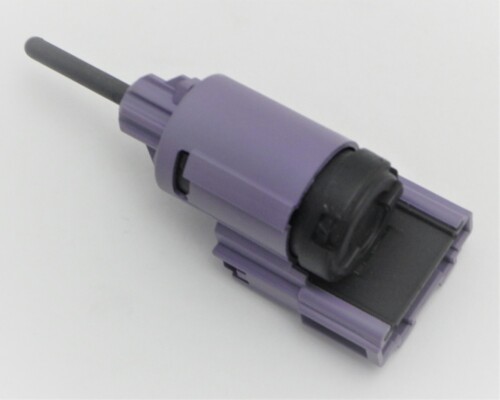
However, on earlier Cayenne models, one of the more straightforward causes to check is the brake light switch. This small switch tells the vehicle that the brake pedal has been pressed and provides a signal used by several of the onboard safety and starting systems.
The switch is operated by movement of the brake pedal. When the pedal is pressed, the switch changes state, illuminates the brake lights and provides a brake-applied signal to systems that require it. Exactly how that signal is used varies between Cayenne generations.
Over time, the switch or its adjustment can fail and the brake-applied signal can become unreliable. On affected vehicles, this can trigger ABS or PSM warnings, stop the brake lights working correctly and, where the start sequence requires a valid brake signal, prevent the engine from starting. No brake signal, no start!
PSM Failure Message
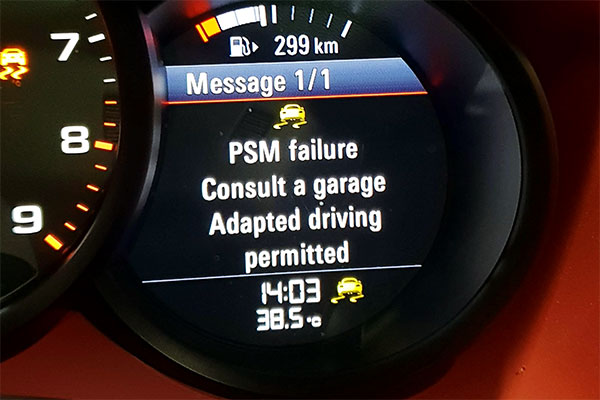 Here’s What to do When You See PSM Failure on Your Porsche Dashboard
PSM failure can be a common issue on the Cayenne, however, because the system is so interconnected, the message PSM failure can be deceptive. The PSM control unit has not necessarily failed. Frequently the warning comes from an input sensor, wiring fault or another connected system, although genuine PSM or hydraulic-unit failures are also possible. The interconnection of the systems can result in the reporting of multiple faults and cause significant confusion to the untrained. Commonly a single sensor failure will report multiple faults in various systems. Proper diagnosis of the root cause will save you money versus part replacement guess work.
On 9Y0 Cayenne models, wheel-speed sensor or sensor-circuit faults are one of the things worth checking when ABS and PSM warnings appear together. Read the individual wheel-speed data and fault codes before ordering parts. If one sensor has failed, replace the failed component and deal with any damaged wiring or encoder-ring problem found during diagnosis. There is no reason to replace all four sensors simply because one has failed.
Brake Booster Fault
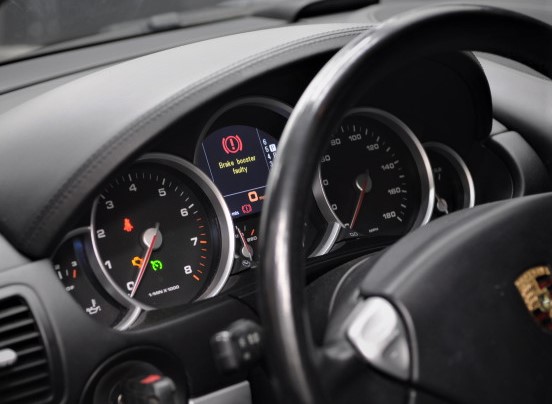 Symptoms: Brake Booster Fault – Dash Message, Harder Brake Pedal
On the earlier Cayenne models with a vacuum-assisted brake booster, the engine vacuum system, vacuum pump and associated pipework play an important part in braking assistance. That is particularly relevant to turbocharged engines and other operating conditions where manifold vacuum is limited. Later E-Hybrid brake systems use a different arrangement and need to be diagnosed accordingly.
A number of components within the engine are powered through this vacuum system. The most common fault set through a failure in this system is that of the brake booster fault.
On the vacuum-assisted systems, the pump and pipework supply vacuum to the brake booster. If the vacuum falls below the required level, the monitoring system can report a brake booster fault on the dashboard. A split vacuum pipe or failed check valve is certainly worth looking for before condemning the booster itself, but the booster, pump, sensor and control circuits all need to be considered. The warning alone doesn’t tell you which part has failed.
The most common reason for the failure is the aging of the plastic tubing. Over time, the hard plastic tubing heats and cools rapidly. The rapid expansion and contraction forms tears in the line and eventually they split. Depending on the engine and the part that has failed, some vacuum lines and check-valve sections are supplied as assemblies. Inspect the complete system before replacing parts. There is little benefit in fixing one brittle connection only to have the adjacent one split on the next drive cycle.
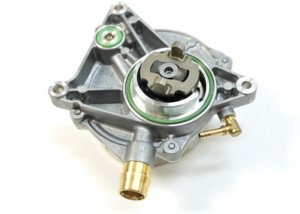 Assuming all the lines are in good shape and hold vacuum, then the problem may well lie with either the vacuum pump itself or the sensor. The correct diagnosis should include a vacuum supply and retention test, the operation of the pump and check valves, and the relevant sensor readings. Some faults are straightforward to repair, but brake assistance is no place for guesswork.
Fault Electric Parking Brake Message
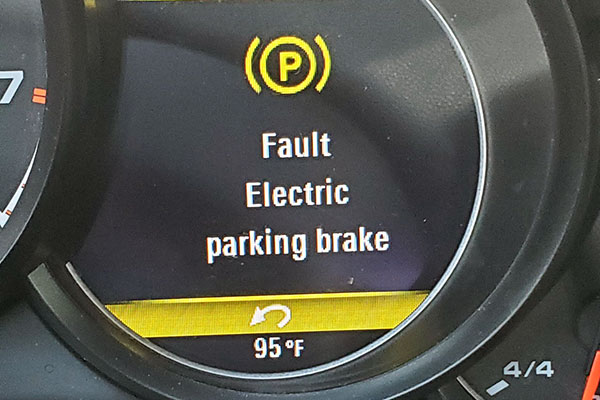 This message means the electric parking brake system has detected a fault while applying, releasing or monitoring the parking brake. On Cayenne models fitted with the electronic system, electric motors and their associated control circuits operate the brake mechanism, and the cause may be electrical or mechanical.
Here’s what to do –First establish whether the parking brake is applied or released and whether the vehicle can be secured safely. If the brake is stuck on, don’t try to drag the Cayenne or force the system to release. A painfully expensive tow charge is preferable to wrecking the rear brakes or allowing the vehicle to roll away! If the warning is red, the brake will not hold the car, or its operation is uncertain, arrange professional assistance rather than driving on.
Multiple Yellow Warnings – Brake Light Switch Code P057200 – 2024–2025 Cayenne
Symptoms: Multiple Yellow Dashboard Warnings, Brake Light Switch Fault P057200 – 2024–2025 Cayenne (9YA / 9YB)
You press the brake pedal, the dashboard lights up with several yellow warnings, and suddenly it looks as if half the car has developed a problem at the same time. The obvious suspect is the brake light switch, especially when a diagnostic scan reports P057200. However, replacing the switch on these Cayennes may be solving the wrong problem.
Porsche Technical Information 93/25 describes a disagreement between the brake pedal information coming from the booster distance sensor and the brake light switch. With the relevant older DME software, the signals can disagree when the pedal is pressed lightly and the system reports a fault even though the switch itself may not be defective. Porsche instructs the workshop to reprogram the DME before fitting a new switch for this particular code and symptom combination.
That doesn’t mean every P057200 fault is software. A damaged switch, wiring problem or genuine brake-system fault still needs investigating. The sensible first step is to have a Porsche specialist read the DME and PSM faults, confirm the software status and carry out the Porsche test procedure. It’s a lot cheaper than replacing good components because the dashboard put on a light show.
Brake Pedal Does Not Return Fully After Braking – 958
Symptoms: Brake Pedal Slow to Return or Does Not Return Fully After Being Pressed – 2011–2014 Cayenne (958 / 92A)
A brake pedal that stays slightly depressed or takes its time returning after you take your foot off is not normal. On an early 958 Cayenne, this can be a problem with the pedal mounting rather than the hydraulics or the brake booster.
Porsche documented a condition on certain 2011–2014 Cayennes where heat and humidity can cause the brake pedal bearing arrangement to bind. The pedal then needs more force to return to its normal position, and in some cases it does not return completely. Porsche Technical Information 27/13 specifies a revised brake pedal mount to correct the problem.
Of course, a pedal that does not return properly can also be caused by other mechanical or hydraulic faults. If the pedal is sticking, the brakes drag, the car will not slow normally or the brake lights stay illuminated, stop using the vehicle and have the brake system inspected. A good Porsche specialist can check the pedal pivot and booster linkage before somebody starts replacing a master cylinder that was perfectly healthy.
Loose Brake Pedal or Loss of Pedal Control – AG02 Safety Recall - 2011–2016 Cayenne
Symptoms: Loose or Dislodged Brake Pedal, Abnormal Pedal Movement – Selected 2011–2016 Cayenne (958 / 92A)
There is a brake pedal problem on the 958 that should never be dismissed as ordinary wear. Porsche issued the AG02 safety recall after identifying a possible missing retaining circlip on the brake pedal pivot assembly. Without the clip, the pivot pin can work its way out of position and the pedal may no longer operate correctly. Clearly, losing the ability to apply the brakes is about as serious as it gets.
The U.S. recall covers certain 2011–2016 Cayennes, not automatically every car of those model years. Porsche’s remedy is to inspect the pivot retaining clip and install one if required. It is a safety recall, so an owner should have the VIN checked for outstanding campaign work and confirm from the service history that the inspection was completed.
If the brake pedal is loose, moves sideways, has become detached or does not operate normally, do not drive the car to a workshop. Have it transported and inspected. This is one of those occasions where “it will probably be fine” is an expensive gamble with the wrong sort of stakes.
Brake Squeal from Front or Rear – PSCB and PCCB Systems - Cayenne 9YA / 9YB
Symptoms: Squeal at Low Speed, Squeak Just Before Stopping, Rear Brake Noise Without Braking, High-Pitched Front Brake Noise – Cayenne 9YA / 9YB With PSCB or PCCB
A little brake noise does not necessarily mean the brakes are about to fail. However, the type of brake fitted to your Cayenne matters, particularly if it has the Porsche Surface Coated Brakes (PSCB) or Porsche Ceramic Composite Brakes (PCCB). These systems are not the same as the conventional steel brakes, and neither are the costs of replacing the parts!
On certain 2018–2022 Cayennes with PSCB, Porsche documented a front-axle squeak at low speed or under light braking, often just before the car stops. Porsche Technical Information 120/22 identifies updated PSCB discs with improved noise characteristics and specifies replacement of the relevant front discs and pads when the complaint is confirmed. A different Porsche bulletin, ATI 2119, describes a rear squeal on some 2019-onward PSCB cars even when the driver is not braking. In that case, corrosion on the inner brake bell can cause vibration, and Porsche introduced a revised rear disc finish.
There is also a newer PCCB-specific complaint. Porsche TI 77/26, revised in September 2026, covers certain 2024-onward Cayennes fitted with the specified ceramic-brake options. A front brake squeal matching Porsche’s reference sound can require updated front calipers and pads. It does NOT mean every squeaking Cayenne needs a complete ceramic-brake overhaul.
First confirm which brake system is fitted, when the noise happens and whether the pads, discs and associated hardware are actually healthy. A squeal is very different from grinding, brake judder or a change in stopping performance. We recommend a Porsche specialist who knows the different braking systems before a simple noise complaint turns into an extraordinary parts bill.
Long Brake Pedal with Squeaking or Scraping – 9Y0 E-Hybrid
Symptoms: Longer Than Normal Brake Pedal Travel With Squeaking or Scraping Under Light Braking – 2020–2024 Cayenne E-Hybrid (9YA / 9YB)
On a Cayenne E-Hybrid, a long brake pedal accompanied by squeaking or scraping deserves more investigation than the usual discussion about noisy brake pads. The braking system blends regenerative braking with the conventional friction brakes, and complaints can become particularly noticeable when the car relies more heavily on the friction brakes after a period of parking.
Porsche Advanced Technical Information 2530 identifies a specific combination of longer pedal travel and a squeak or scrape under light to moderate braking on 2020–2024 Cayenne plug-in hybrids. Porsche directs the workshop to check for runout at the brake discs and wheel hubs, because that movement can create pressure pulsations in the hydraulic system and noise inside the car. The workshop should also look for signs of impact or previous accident damage before deciding what needs replacing.
This is NOT the same as the yellow PSM-failed / P05FF00 fault discussed in the Hybrid section above, and it is not a blanket diagnosis of warped brake discs. If the pedal is unusually long, the braking effect is reduced or a brake warning appears, stop safely and have the car inspected. Only after the car has been made safe should the shop work through the actual fault codes and measured disc and hub runout. Guessing is not a brake repair strategy.
Suspension and Steering
Chassis System Failure - Suspension Problems - PASM Fault
S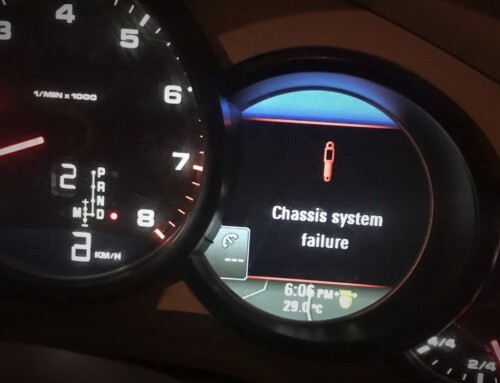 ymptoms: Chassis System Failure Message, Uneven Ride Height, PASM Fault
This fault becomes evident on your Cayenne dashboard when a malfunction occurs in the chassis or suspension system. On air-ride models, that can involve the ride-height system, but a PASM fault can also occur on a Cayenne fitted with conventional steel springs. The system has a number of components, but generally, only one failure indicator. Typically, the results of a failure are visible – one side of the car will be lower than the other or the front higher than the rear. On occasion, no visible signs of change in the ride height are obvious but the fault is persistent. In colder climates, the fault can be sporadic initially, based on air temperature. Cold weather can expose moisture, marginal seals or electrical connection problems, but the temperature alone doesn’t identify the failed component.
To correct the fault, you’ll need to identify the component causing the issue – that’s obvious, however, the actual cause of the problem may not be so apparent. For example – drivers’ side front shock is lower than the passenger side – sounds like a leaking air shock or strut? Maybe, but it could also be a ride height sensor, leaking hose, faulty valve block or bad electrical connector!
Diagnosing Air Ride Suspension on a Cayenne
Components and Common Failures
Air compressor
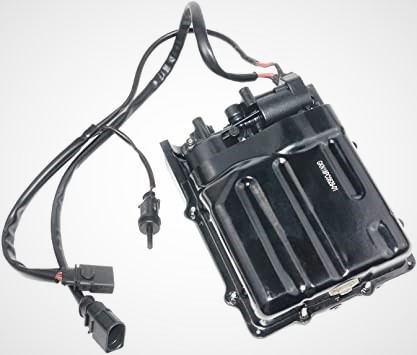 The air compressor supplies the system with compressed air, usually through the air supply and valve arrangement that also charges the reservoir tank. The reservoir helps the system respond quickly to ride-height changes. The compressor is designed to run in short bursts to top off the tank.
With a leak, the compressor may run much more frequently or for longer periods as it tries to restore the system pressure. Eventually it can overheat or be shut down by the control system. Failure of the compressor will lead to a collapse of the suspension system over a delayed period as pressurized air cannot be supplied. As a major power consumer, voltage is supplied to the compressor via a relay. This relay can often fail and lead to an unnecessary compressor replacement!
Air tank
The air supply tank is the least likely area of failure. This simply stores the compressed air to enable enough volume to be delivered quickly to correct the vehicle ride height. The tank supplies air to the system via the valve block – a leak in the line from the tank to the valve block can reduce the air available to the system and cause widespread ride-height problems.
Valve Block
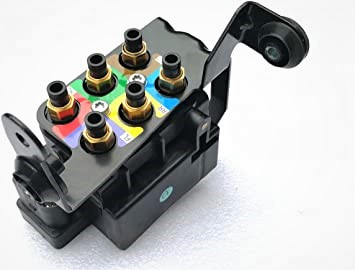 Compressed air is supplied to the valve block from the air tank. The valve block is an electro-mechanical device that routes pressurized air to the individual system components per instructions sent from the control module. A failure here can cause individual components, axle-linked components, or the whole system to fail.
Air lines or hoses
The air hoses travel from the valve block to the individual system components. Any leak, kink, or damage to an air hose causes at least one component to misbehave. Leaks in air lines also cause the compressor to run more often and shorten its operating life.
Front Air Shocks or Struts – Rear Air Spring
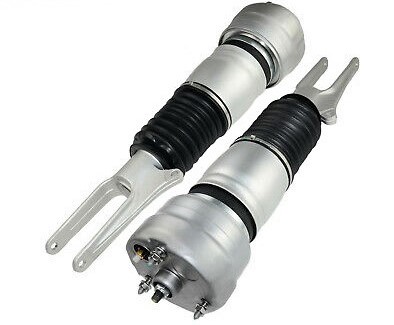 The air ride shock, strut or spring is filled or indeed emptied of compressed air via the air hose and valve block. Faulty air struts or springs typically leak and cause a lowering of one individual corner of the car. Two failing at the same time is unusual, so if you have a lower than normal ride height across one axle, do not assume leaking struts – see level sensors below. Sometimes, a faulty ride-height signal or a problem in the valve block can cause the system to inflate a corner too far, leaving it much higher than it should be. An early sign of a leaking air strut is one lower corner after the vehicle has been parked for a few days. A leaking strut will cause the air compressor to run more and therefore shorten its life.
Electrical connectors
There are electrical connections to the electronically controlled dampers, ride-height sensors and other suspension components, depending on the system fitted. PASM controls damper stiffness through its electronically operated valves. Ride-height adjustment on the air suspension is a separate function, controlled using height information and the air supply system. This is also the basis of the PASM system to enable ride changes from sport to comfort.
The electrical connectors can become corroded or greened in some circumstances. This causes the system to report malfunctions but typically does not affect ride height. Ride height can certainly be affected if the connector to a ride-height sensor is corroded or damaged.
Ride Height Level sensors
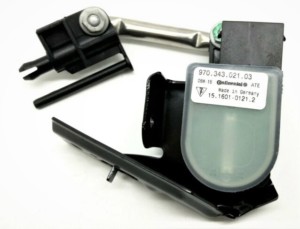 The ride height sensor is a small electro-mechanical component that connects the suspension to the body of the car. A small plastic arm translates vertical vehicle movement into rotational movement in the sensor. Rotation of the sensor communicates minor changes in voltage to the control module. Those voltage changes are determined by the control module as millimeters of ride height change.
The sensor is a critical component because the suspension control module uses the height signal to decide what adjustments are required. Depending on the model and equipment, this information can also be shared with other chassis and lighting systems. Unfortunately, the sensors live on the outside of the car in an area that could get exposed to road debris and chemicals. Failure of these sensitive components is inevitable.
Ride height sensor faults can be fun! A dead sensor is straightforward to diagnose – no signal. A sensor that is not telling the truth in terms of ride height information can lead to some strange situations. Because a ride height signal is still reaching the control module from a faulty sensor, action is taken based on that faulty information. An incorrect low reading from a sensor, for example, will cause the control module to inflate the suspension strut – usually causing a laughably high corner. Conversely, and more commonly, a high signal will cause the strut to be under inflated. This looks like a leak and is commonly mis-diagnosed.
Suspension Control Module
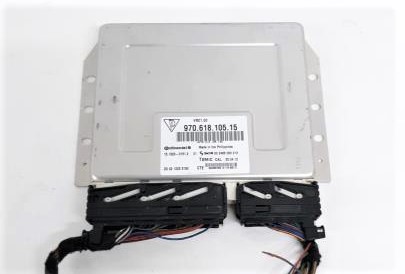 The suspension control module runs the whole system and communicates information to other vehicle systems. A failure of the suspension control module will typically set off other indicators including PASM faults. The control module is one of the least likely items in the system to fail. A control-module failure can disable some or all of the suspension functions, or cause communication faults with other chassis systems. However, a warning message or loss of communication doesn’t automatically mean the module is defective – Porsche has issued software fixes for exactly that sort of complaint.
Switches
Switch failure is commonly overlooked. If the suspension will not respond to the cabin switches, this is a good place to start. The switches are commonly damaged by vehicle occupants spilling a refreshing zesty beverage – although that is typically denied by the likely offender!
Electronic Power Steering Fault
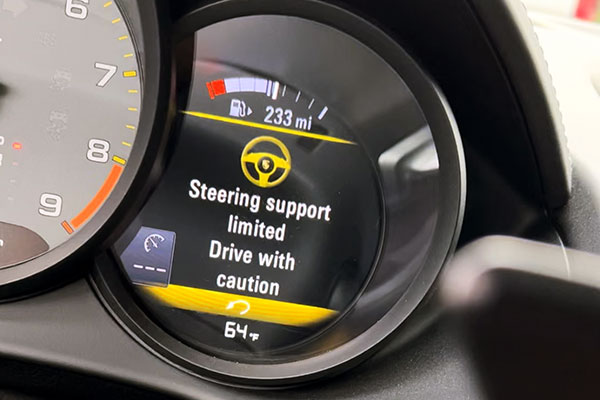 The first Cayenne models used hydraulic power steering, while later models introduced electrically assisted steering systems. The exact arrangement depends on the generation and, in some cases, the engine or hybrid equipment. Fault messages associated with the power steering often indicate reduced or lost steering assistance. Some yellow warnings may permit carefully limited driving, but don’t assume it is safe to continue – follow the exact warning displayed. If steering effort increases suddenly or a red steering warning appears, stop safely and arrange assistance. This means the steering will feel heavy and requires more effort. This can be a potentially dangerous situation and should be diagnosed as quickly as possible.
Failure of the electronic steering rack is not that common. These faults can result from low system voltage, poor electrical connections, fuses or power-supply problems, software or control-module faults, as well as a failure within the steering system itself. Start with a proper scan and supply-voltage checks rather than condemning an expensive steering rack or assuming a relay has failed.
Chassis System Fault - PDCC
 Symptoms: Chassis System Fault Message, Suspensions Noises, Loud Noise from PDCC Pump, Fluid Leaks
This fault becomes evident on your Cayenne dashboard when a malfunction occurs in the Porsche Dynamic Chassis Control System – PDCC. The system has several components, but generally, only one failure indicator.
On the earlier 955/957 and 958 Cayenne models, PDCC is a hydraulic system operated by a pump and designed to reduce lateral body movement during cornering maneuvers. The third-generation 9Y0 Cayenne uses an entirely different 48-volt electromechanical PDCC system, so the hydraulic faults and repairs below do not apply to those later cars. It can also mitigate the lateral instability of the vehicle on uneven surfaces. This is done by pushing fluid into and out of the chassis stabilizers or anti-roll bars.
PDCC Components That Fail
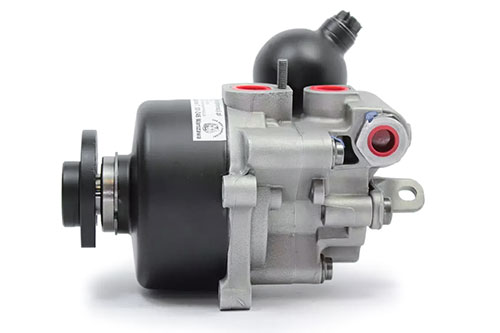 PDCC Hydraulic Pump
On the earlier hydraulic PDCC system, the PDCC pump is clearly an integral part of the system. Without the pump constantly providing the right pressure, the system quickly fails. The fluid reservoir for the hydraulic PDCC system contains the system filter and is a scheduled maintenance item on the relevant older Cayenne models. For example, Porsche lists PDCC reservoir replacement at 60,000 miles or six years on its 958 maintenance checklist. The pump is expensive, but often failure of the pump is caused by a system leak – just replacing the pump if you have a leak, can lead to quickly needing to replace the pump again!
PDCC Valve Body
The valve body can fail for several reasons, including contamination in the hydraulic fluid, corrosion, valve faults or electrical problems. Neglected reservoir maintenance certainly doesn’t help.
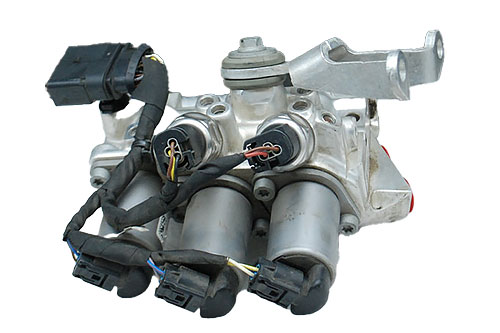
PDCC Pressure Sensor
The PDCC pressure sensors determine the pressure in each line via the system valve body. Corrosion, wiring problems or a failed sensor can produce incorrect pressure information and trigger a PDCC warning. Check the electrical connections and live pressure data before replacing parts.
Leaking Lines and Connections
Many of the problems associated with the PDCC are caused by corrosion of the system lines or connections to the active suspension components. The corrosion of a supply line can cause a leak, loss of pressure, and eventually failure of the pump. The lines and connections are particularly susceptible to road chemicals used in the northern states.
Replacing Components and Bleeding the PDCC System – Correct Procedure Required
The earlier hydraulic PDCC system requires a specific bleeding procedure after certain repairs or component replacements. The procedure involves activating the system with Porsche-compatible diagnostic equipment such as PIWIS. Failing to bleed the system correctly can be very expensive. We recommend you work with a Porsche specialist if you have a PDCC problem.
Cayenne Standard Suspension Check Points
The Cayenne suspension is generally extremely durable, but age, mileage, road conditions and spirited driving will eventually take their toll on the bushings, joints and shock absorbers. However, rubber bushings and struts can be worn with age or spirited driving. Listen for clunks or squeaks and check for fluid leaks from suspension struts. The most common issues are as follows:
Worn Control Arm Bushings
- Symptoms: Clunking noise over bumps, uneven tire wear, loose steering feel.
- Cause: Original rubber bushings degrade over time.
- Fix: Replace control arms or bushings.
Failed Lower Control Arms
- Symptoms: Clunking, instability under braking, poor alignment retention.
- Fix: Replace with OEM or upgraded units
Top Mounts / Strut Mounts
- Symptoms: Squeaking, clunking over bumps, poor ride quality.
- Fix: Inspect the mounts and bearings, and replace the worn components.
Worn or Leaking Shocks or Struts
- Symptoms: Bouncy ride, nose dive when braking, poor cornering stability.
- Fix: Replace shocks or struts
Sway Bar End Links & Bushings
- Symptoms: Clunks or rattles during cornering.
- Fix: Replace worn end links or sway bar bushings.
Alignment & Ride Height Issues
- Symptoms: Pulling to one side, excessive inner tire wear.
Chassis Warning, Control Unit Not Responding – 2024 Cayenne
Symptoms: Yellow Chassis Warning, PASM / Chassis Control Unavailable, System Sometimes Works Again After Restart
Not every chassis fault means the suspension is broken. That may sound obvious, but it is a fairly expensive distinction if the workshop starts replacing parts before checking the Porsche technical information!
Porsche identified a software problem in the chassis-control unit on certain 2024 Cayennes. During start-up, the control unit may fail to complete its initialization. Communication with the unit can then be lost, sometimes making it impossible for the workshop to access the module for diagnosis until the ignition has been cycled.
Porsche workshop campaign WRA8 instructs dealers to reprogram the chassis control unit with updated software. The published campaign information lists a remedy and a March 7, 2029 campaign closing date. However, the campaign is assigned by VIN, so a 2024 Cayenne with an unrelated chassis warning is not automatically covered.
Before authorizing an expensive control-unit or suspension replacement, have a Porsche specialist check the VIN and confirm which systems are communicating, along with the software level and stored fault history.
Front Suspension Drops, Yellow or Red Chassis Warning – 2023 Cayenne
Symptoms: Front of Car Sitting Low, Chassis Malfunction Message, Vehicle Extremely Low Warning
An air-suspension leak at the front of a Cayenne looks much like any other failed strut. The front drops, the compressor tries to keep up and eventually the dashboard joins the conversation. Unfortunately, the failure is not always where you would first expect to find it.
Porsche Technical Information 43/25 identifies a specific concern on 2023 air-suspension Cayennes: a leak at the plastic welded seam on a front air spring strut. The workshop is instructed to inspect the seam and, when that particular fault is confirmed, replace both front air spring struts. This is not a recommendation to replace two struts for every minor air leak.
If the chassis is very low or a red stop warning appears, do not continue driving. An experienced Porsche specialist should check the air struts and connections under the correct test conditions before condemning the compressor or valve block. For this fault, the precise location of the leak matters.
Rear Air Suspension Sags or Cayenne Sits Unevenly – 2024 Models
Symptoms: Rear of Car Sitting Low, Uneven Ride Height, Air Suspension Warning
An individual Cayenne air spring can leak as it ages, but Porsche also identified a manufacturing issue with the rear air bellows fitted to a particular group of 2024 Cayennes.
Under workshop campaign WPM9, Porsche found that rear air bellows on affected cars may not meet the required manufacturing specification. The bellows could lose pressure during their service life and allow the vehicle to tilt or sit unevenly. Porsche’s repair procedure is to replace both rear air spring bellows on vehicles assigned to the campaign.
This is important because it can look like an ordinary age-related air-spring leak. Before paying for rear suspension repairs on a 2024 Cayenne, have the workshop check the VIN for outstanding campaigns. As always, a Cayenne that sits low on one side still needs a proper leak and ride-height diagnosis if no applicable campaign is found.
Yellow Chassis Warning and Pressure Sensor Fault Codes – 2024–2026 Cayenne
Symptoms: Yellow Chassis System Fault, Adaptive Suspension Pressure Sensor Implausible Signal, Intermittent Fault Following Start-Up
Here’s a good example of why a fault code should be treated as a clue rather than an instruction to replace the part named in the description.
Porsche Advanced Technical Information 2605.2, revised October 2026, describes a specific yellow chassis warning on certain 2024–2026 Cayennes. The control unit records four versions of code C103129 – DTC 31001A, 31001B, 310018 and 310019 – all with exactly the same timestamp. Porsche found that a brief voltage drop at the chassis control unit during engine start can produce this group of implausible pressure-sensor signals.
For the precise four-code pattern described in the bulletin, Porsche now instructs workshops to update the chassis control unit to software version 1122 before moving on to further diagnosis. The earlier bulletin proposed a different interim approach while the software was being developed, so it is important that the workshop uses the latest revision.
Do not conclude that a new pressure sensor, new air struts or even a new battery is required simply because this warning appears. If the four faults do not share the same timestamp, or the car has other symptoms, the technician must investigate the actual fault rather than apply this software procedure blindly.
Steering Assistance Fault and Steering Gear Campaign – 2024 Cayenne
Symptoms: Steering Fault Warning, Unusual Steering Assistance or Workshop Concern About Steering Gear
A steering warning on a late Cayenne does not automatically mean the steering rack has failed. However, Porsche did identify a specific power-steering gear quality concern in a limited group of 2024 Cayennes.
Porsche campaign WRC6 requires the steering gear on affected vehicles to be checked and replaced if necessary. Porsche’s own documentation makes the distinction between inspecting the component and replacing it – this is not an instruction to fit a new rack to every Cayenne with a steering message.
Ask the specialist to confirm the VIN campaign status and diagnose any steering warning separately. If the steering suddenly becomes heavy, unpredictable or cannot be controlled normally, stop safely and arrange recovery rather than attempting to drive home. The steering system is not a sensible place for a bit of trial and error.
Rear-Axle Steering Fault After Software Update – 2024-Onward Cayenne
Symptoms: Rear-Axle Steering Warning, Function Restricted, Fault B200FF0 Following Workshop Programming
Later Cayennes can be fitted with rear-axle steering. At low speed, the rear wheels steer in the opposite direction from the fronts to improve maneuverability. At higher speeds they work together to improve stability. Consequently, a fault in this system deserves proper investigation.
Porsche Technical Information 180/23 describes a very particular problem that can occur after a workshop carries out certain software measures. The rear-axle steering control unit may store B200FF0 – control unit function restriction – and the fault may not clear in the usual way.
If the code was generated during the workshop software operation, Porsche specifies a special PIWIS programming procedure to clear it. However, the same bulletin makes an important distinction: if the fault was generated during normal vehicle operation rather than a workshop update, that software repair does not apply, and Porsche directs a different repair involving the rear-axle steering assembly and control unit.
The timing of the fault is therefore critical. Make sure the shop documents whether the fault appeared immediately after software work or while you were driving, and uses the appropriate Porsche procedure. Replacing a rear-steering assembly because of a workshop-induced software code would be an expensive misunderstanding.
Front Control Arm Safety Recall – 2024 Cayenne
Symptoms: Possible Front Suspension Control Arm Failure, Unstable Steering or Wheel Control – Affected VINs May Have No Warning
Not every suspension problem announces itself with a clunk or a warning light. In 2024 Porsche recalled a limited group of Cayennes because the left front upper control arm may have been manufactured with a defect.
Porsche and NHTSA reported that the affected component could fracture under load, potentially causing loss of steering or wheel control. This is a genuine safety concern, not another case of a worn rubber bushing that can be dealt with at the next service.
The recall is Porsche campaign ARB2, NHTSA 24V-533. Porsche dealers replace the affected left front upper control arm free of charge. The reported production window was May 9 to June 19, 2024, but the VIN is what determines whether an individual Cayenne was included and whether the work has already been completed.
If you have a 2024 Cayenne and are unsure, check the VIN with Porsche or the NHTSA recall database. If it is subject to an open safety recall or the steering feels unstable, arrange the required inspection and repair promptly. Don’t ignore a potential structural suspension fault.
Bodywork
Tailgate and Door Handle Issues
The tailgate on the Cayenne has a few issues that are usually easy to identify. Some are straightforward to solve; others are a little more involved than they first appear.
Tailgate wont stay open – this is probably one of the cheaper parts problems on the 955 or 957 Cayenne. The gas struts that hold the tailgate open weaken, and in cold weather in particular, you can find the tailgate dropping on your head easily! The fix is to replace the gas struts, but don’t mistake inexpensive parts for a five-minute job. On the 955 and 957, the hatch and separate rear-window struts sit behind the rear roof trim, so access involves some interior dismantling and correctly re-sealing the strut covers. The hatch is heavy, so make sure it is properly supported while the work is done. Check that the separate rear glass and the hood also stay up; their support struts can weaken with age too.
Rear wiper, tailgate locking, or license plate lights stop working – Each of these components can fail individually. However, a common cause is a problem with the electrical supply or wiring to the tailgate. The components are connected through a wiring harness that passes from the body into the tailgate. Over time, the wires can become fatigued and break where they flex as the tailgate opens and closes. Check the individual fuses, the harness and its connections before replacing the affected component.
Electronic Tailgate
The later Cayenne, including the 958 and 9Y0 generations, can have an electrically operated tailgate with power opening and closing. The opening height can be stored, and, depending on the model and equipment, the tailgate can be operated from the exterior release, the driver’s door, the key fob or the button on the tailgate itself. A powered closing latch secures the tailgate at the end of travel, while some later cars also have the hands-free opening feature operated from beneath the rear bumper.
The tailgate has a reputation of being finicky and can experience a number of issues:
- Stops mid-close or mid-open – tailgate reverses, beeps
- Doesn’t open to saved height – stops early even though the opening height has been correctly stored
- Won’t latch fully – closes but warning shows tailgate open
- Rattles or clicks when driving – noise from the rear hatch or latch area
- Slow to respond in cold weather – moves sluggishly or stops
Some of these problems are mechanical, while others involve the powered struts, latch, wiring, control unit or stored opening position. The trick is to establish which one you actually have before ordering parts. Porsche has specific diagnostic procedures for checking the current drawn by the powered struts, and on some earlier 958 models a reported strut fault can be misleading. In other circumstances, the tailgate may need its operation or end position checked or recalibrated using PIWIS. Replacing the complete motor assembly on a guess can be an expensive way to discover the fault was somewhere else!
Door handles – sounds obvious, but check the opening, closing and locking of all the doors before you buy the 955 or 957 Cayenne. Individual door handles can break internally, and door locking mechanisms can also fail individually. If the Cayenne is fitted with KESSY, pay particular attention to the locking of individual doors and the communication between the key and the car. A failed door handle or lock mechanism is not necessarily the same fault as a failed KESSY antenna or key recognition problem, so it pays to identify which part of the system has stopped working. KESSY problems can be more expensive to solve. On the later 9Y0 Cayenne, there is also a specific Porsche-documented problem with the exterior handle material — see the separate fault below.
Cracked or Broken Exterior Door Handles – 2019–2021 Cayenne
Symptoms: Hairline Cracks in Painted Door Handles, Cracks Getting Larger, Exterior Handle Breaking – 2019–2021 Cayenne
A small crack appearing in the paint on a door handle is easy to dismiss as cosmetic damage. On some 2019–2021 Cayennes, however, Porsche identified a problem with the material used in the exterior handle itself. What initially looks like a paint crack can gradually develop into a much larger crack and the handle may eventually break.
Porsche Advanced Technical Information 2000.1 identifies an incompatibility in the handle material on vehicles fitted with the specified keyless-entry equipment. The bulletin advises replacement when the crack has progressed beyond a fine hairline, rather than assuming every tiny surface mark requires a new handle.
If you find cracking on a relatively new Cayenne, have a specialist inspect the handle itself before sending the car for paintwork. Repainting a handle with a structural crack will not solve the underlying problem. Check both front and rear handles for damage and confirm the relevant equipment and warranty position before ordering parts.
Electric Tailgate Moves Erratically – 958 Fault 00001E
Symptoms: Rear Lid Stops, Moves Unevenly or Fails to Close Correctly, Fault 00001E – Early 958 Cayenne
The electric tailgate on the 958 can develop a mind of its own. It may stop part-way through opening, hesitate, reverse direction or behave differently from one operation to the next. It is tempting to blame whichever powered strut the diagnostic computer identifies, but that can be an expensive mistake.
Porsche Advanced Technical Information 1705 describes a fault recorded as 00001E for the right-hand rear-lid strut even though the actual problem may be with the left-hand strut. Porsche also identifies control-unit software and moisture entering the rear-lid control unit as possible causes. In other words, a fault description naming a component is not proof that component is broken.
The sensible starting point is to scan the rear-lid control unit, inspect both struts and their wiring, check for signs of water damage and confirm the software. Porsche also describes using PIWIS to compare the electrical current drawn by each powered strut as it moves. A binding mechanism will require more effort and can be identified without simply replacing both struts. Get the diagnosis right first — the tailgate has enough moving parts without adding unnecessary new ones!
Rear Tailgate Rattle or Squeak – 2024-Onward Cayenne
Symptoms: Rattling, Clicking or Squeaking from the Closed Rear Tailgate – 2024 + Cayenne
A rattle from the back of the Cayenne can be surprisingly difficult to pin down. It sounds as though a piece of trim or something in the cargo area is loose, but on some 2024-onward models the noise comes from movement at the rear-lid locking mechanism itself.
Porsche Technical Information 62/24 identifies movement between the latch catch and locking hook caused by the way the tailgate assembly is pre-tensioned. The latest revised factory procedure, issued in November 2025, starts by checking and adjusting the rear-lid guide wedges. The latch is then inspected and, if necessary, the locking hook is reworked. This is not automatically a case for replacing the complete tailgate lock.
Before pulling the interior apart or ordering an expensive latch, have the shop reproduce the noise and make sure it actually comes from the lock area. A loose cargo cover, interior trim or another component can make much the same noise. If the latch is the source, ask the shop to follow the revised Porsche procedure rather than the earlier version of the bulletin.
Panoramic Roof Sticks, Reverses or Won’t Close – 958 Cayenne
Symptoms: Panoramic Roof Stops Part-Way, Reverses During Closing, Makes Cracking Noises or Sunblind Will Not Move – 958 Cayenne
The panoramic roof is a lovely feature until it decides not to close! Some 958 owners have reported the roof starting to move and then stopping, reversing just before it closes, or making a clicking or cracking sound. The electrically operated sunblind can also become stuck, sometimes at the same time as the roof itself.
There is more than one possible cause. Dirt or increased resistance in the guides, a binding cable or mechanism, an electrical drive problem or lost end-position settings can all produce similar symptoms. Porsche’s 958 owner’s manual explains that the stored roof and sunblind end positions can be lost after a flat or disconnected battery, fuse replacement or emergency operation. The manual has a specific end-position learning procedure for the roof and a separate one for the blind.
Start with a careful inspection of the visible guides, seals and movement of the roof, followed by the correct model-specific initialization procedure where appropriate. If the roof is physically jammed or the drive is skipping, don’t keep forcing it with the switch or the manual drive. Broken cables and guide components can turn an annoying problem into a major headliner-out repair. A workshop familiar with the Cayenne roof mechanism is a much better bet than guessing that the motor has failed.
This is a different fault from water entering the cabin through blocked roof drains. If the symptom is a wet headliner or carpets after rain, see the existing “Water Leaks – Blocked Drains and Electrical System Damage” section rather than repeating that discussion here.
Exterior Lighting
Cracked Taillight Lenses – Early 9Y0 Cayenne
Symptoms: Fine Cracks Along Taillight Edges, Shiny Lines in the Lens, Cracks Spreading Around the Rear Light – Certain 2018–2019 Cayenne Models
On some early third-generation Cayenne models, the taillights can develop small cracks around the edges. Initially the damage can look like a shiny line where the lens meets the bodywork. As it progresses, more substantial cracking becomes visible. It is easy to assume the light has been knocked or damaged during a repair, but Porsche identified a production-related issue with these assemblies.
Porsche Technical Information 161/18 covers the visual defect on affected 2018–2019 Cayenne models, with particular attention to vehicles produced up to November 18, 2018. The bulletin distinguishes slight surface defects from more serious cracks and provides a procedure for assessing the lamps. Porsche also issued Technical Information 64/20 describing a special extended warranty of four years from delivery or 125,000 miles, whichever came first, for qualifying taillights. That coverage should not be assumed to remain active now; the vehicle delivery date and Porsche PCSS record determine the position.
Before buying replacement rear lights, photograph the cracks, check whether they are superficial or extend through the lens, and ask your Porsche specialist to identify the latest part specification. If moisture is entering the assembly or a lighting function has failed, the problem is no longer just cosmetic. We would certainly check this area on any used early 9Y0 Cayenne.
Front Turn Signal Fault – Indicator Flashes White or Stops Working – 9Y0
Symptoms: Front Direction Indicator Defective Warning, Rapid Indicator Flashing, Turn Signal Flashes White or Stops Flashing Amber – Certain 2019–2023 Cayenne Models with Basic LED Headlights
An indicator that suddenly flashes white instead of amber is an unusual fault, even by modern Porsche standards. On certain Cayenne models with basic LED headlights (equipment code 8IT), the front direction indicator may stop operating correctly and the instrument cluster reports a left- or right-side fault. The workshop may find code C11A401, described as an electrical fault in the bumper direction indicator.
Porsche Technical Information 231/24, published in January 2025, explains that low vehicle voltage can trigger incorrect fault detection in the headlight electronics. The resulting software response disables the normal amber flashing function. Stop-and-go traffic, extended idle periods and reduced battery voltage can make the problem more likely. Crucially, Porsche instructs workshops to recode both the left and right headlight control units with the current PIWIS software. Replacing the lighting hardware does not remedy this particular fault.
We recommend checking battery condition and charging voltage, confirming the installed headlight equipment and reading the stored codes before approving any parts. A software correction is a rather better outcome than buying headlights only to discover that the new ones behave exactly like the old ones.
Tail Light Faulty Warning or Brake Lights Flash After Locking – 2024–2025 Cayenne
Symptoms: Intermittent Left or Right Tail Light Fault Warning, Rear Lights Appear to Work Normally, Brake Lights Illuminate Briefly After Locking – 2024–2025 Cayenne
A warning telling you that a taillight has failed should be taken seriously, particularly if the brake lights or rear indicators are actually not working. However, Porsche has documented a rather odd problem on certain 2024–2025 Cayenne models in which the dashboard announces a taillight fault even though the light appears to work normally. Some owners may also notice the brake lights briefly illuminating after the vehicle has been locked.
Porsche Technical Information 57/25, updated in January 2026, identifies a rare software error within the rear light assemblies. The rear body control module may log B16D6F2, B16D4F2, B16D7F1 or B16D5F1. Unfortunately, the same warning can also appear when an LED module really has failed, so checking the lamps is essential. For the specific problem described in the bulletin, Porsche specifies replacement of the left, right and rear-lid taillights with versions using optimized software; the bulletin does not direct a simple coding update.
Have the workshop demonstrate what is happening and check the fault memory before deciding on the repair. Do not dismiss a real brake-light failure as a harmless software message, but equally do not condemn individual control modules on the basis of a warning alone. This is precisely why a Porsche-specific technical bulletin can save a lot of expensive guesswork.
Still Can’t Find An Answer? – Contact Us For More Help
If your Cayenne has mechanical issues that don’t appear here, simply drop us an email via the forms or pop-up contact and we’ll do our best to share a solution with you.
